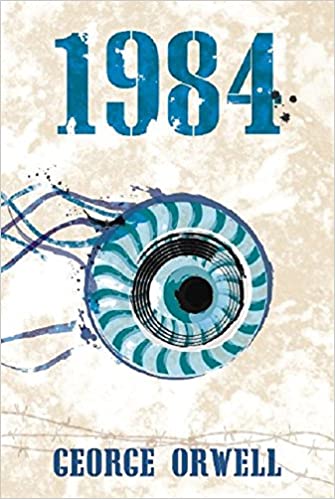
We are not content with negative obedience… We convert him, we capture his inner mind, we reshape him… It is intolerable to us that an erroneous thought should exist anywhere in the world.
These chilling words spoken by O’Brien to Winston Smith lie at the heart of George Orwell’s Nineteen Eighty-Four. The words capture the true horror of the world Orwell imagine where the state not only want physical domination alone, but the complete annihilation of independent thought.
Why I Picked This Book
Nineteen Eighty-Four is widely regarded as one of the greatest dystopian novels ever written. First published in 1949, it presents a terrifying vision of a future society set in the year 1984. Though written decades ago, the novel feels disturbingly relevant today. As one observes how societies across the world, and particularly in India are evolving, Orwell’s work appears almost prophetic. That unsettling relevance was reason enough for me to pick up this book.
The World of Nineteen Eighty-Four
At its core, Nineteen Eighty-Four is the story of Winston Smith, an ordinary man living under a totalitarian regime in the superstate of Oceania. Winston is a member of the Outer Party and works at the Ministry of Truth, or “Minitrue” in Newspeak—the official language of the state. His job involves altering historical records to align them with the Party’s ever-changing narrative, ensuring that the Party is always right and infallible.
Oceania is ruled by the omnipresent Big Brother, a figure elevated almost to the status of a god. In this world, nothing truly belongs to individuals—not even their thoughts. Citizens are under constant surveillance through telescreens that watch, listen, and monitor every movement. Privacy is nonexistent, and suspicion is a way of life. (Sounds similar? Someone predicted it in 1949)
The Party’s ideology is summed up in three haunting slogans:
War is Peace
Freedom is Slavery
Ignorance is Strength
These contradictions are not meant to be questioned; they are to be accepted without thought. The Party’s greatest achievement lies in its ability to make people believe them sincerely.
Control Beyond the Body
Winston doesn’t like the Party. His small act of rebellion is keeping a diary where he confides his feelings, questioning official truths — considered dangerous crimes in a society where even thinking differently is an offense. Eventually, his dissent catches up with him, and he is arrested.
What follows is not merely imprisonment, but systematic psychological torture. Orwell takes the reader deep into the mechanics of brainwashing, showing how the state breaks Winston down, reshapes his thoughts, and forces him not just to obey Big Brother, but to love him. This is the most terrifying aspect of the novel: the idea that the state does not settle for outward compliance. It demands inner submission.
The novel is written in the immediate aftermath of the Second World War and the rise of totalitarian leaders such as Hitler, Mussolini, and Stalin. Orwell examines how such regimes thrive—not just through fear and violence, but through propaganda, historical manipulation, and the erosion of language itself. (Any similarities here?)
An Uncomfortable Mirror
Reading Nineteen Eighty-Four today, it is difficult not to notice unsettling similarities with our own times. The relentless spread of misinformation, the rewriting of history to suit those in power, the shrinking space for dissent, and the targeting of those who question authority—all echo Orwell’s warnings. When truth becomes malleable and disagreement is branded as disloyalty or anti-national, societies begin to drift dangerously close to the world Orwell imagined.
This is not to claim that we live in a totalitarian state, but rather to recognize the early signs Orwell cautioned us against. Nineteen Eighty-Four serves as a reminder that freedoms are rarely taken away overnight; they are eroded gradually, often with public consent, justified in the name of security, religion, nationalism, historical glory or progress.
Final Thoughts
Nineteen Eighty-Four starts at a measured pace, carefully building its world and premise. Once the machinery of the state and its methods become clear, the narrative grows increasingly gripping and disturbing. It is not an easy or comforting read, but it is a necessary one.
Orwell’s genius lies in his ability to show how absolute power seeks not only to control actions, but to colonize the human mind itself. This novel is more than a work of fiction—it is a warning. One that remains as urgent today as it was when Orwell first wrote it.
A haunting, thought-provoking, and deeply unsettling book that everyone should read at least once.
About the Author
George Orwell, born as Eric Arthur Blair on June 25, 1903 in Bihar, India, was a much-respected English novelist, political author, and journalist who wrote some of the finest pieces in literary criticism, poetry, fiction, and polemical journalism.
His best works include Animal Farm, Nineteen Eighty Four, and Homage to Catalonia. Orwell died at the age of forty-six in 1950.
Similar Book


About the reviewer

Manoj Payal
Manoj is an avid reader and a writer in progress, with interests spanning literature, history, politics, and the social sciences. His writing across book reviews, essays, articles, and poetry—explores ideas, society, and the human experience.He has spent over two decades working in the IT industry, a background that informs his analytical approach to reading and writing.