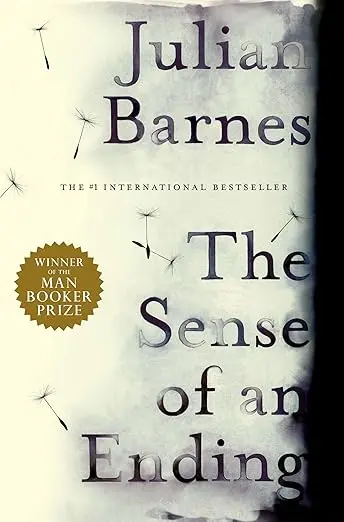
The Sense of an Ending by Julian Barnes is about a man looking back on his school days and the memories of his adult life. It is a reflection on the past and on how we view our lives through our own memory, often forgiving ourselves for the mistakes we have made. The novel explores how we tend to shape our personal stories in a way that makes us appear better, kinder, or more innocent than we may actually have been.
Book: The Sense of an Ending
Author: Julian Barnes
Form: Literary fiction / short novel
Subject: A retired man revisits his past and begins to question the reliability of his memory
Main themes: memory, remorse, ageing, friendship, history, self-deception, guilt, time, and personal narratives
Best for: Readers interested in literary fiction, short philosophical novels, unreliable memory, reflective writing, and Booker Prize-winning fiction
About - The Sense of an Ending
A retired man reminisces about his school days and all his friends and the moments they shared together. All this coming from his memory, the events as he remembers them. The Sense of An Ending raises important points, are our memories the lies that we tell ourselves? Do we really remember things as they were?
Tony Webster goes back down the memory lane to his school days and remembers three of his friends, especially Adrian, who was the most intellectual of them. He recalls small and big events from his school and college life. Tony recalls an interaction between Adrian and history teacher and especially remembers what Adrian has quoted about history.
“History is that certainty produced at the point where the imperfections of memory meet the inadequacies of documentation.”
The first part of the book is about Tony’s recollection of the past and his interpretation of it. His school days, and then all his friends moving out from the town to join college. Adrian was admitted to Cambridge, Tony got a girlfriend, Veronica, in his first year of college, he breaks up with her and then Adrian began dating Veronica. Tony got to know this when he received a letter from Adrian informing him that he is dating Veronica and wanted to let him know. He remembers what he thought about it and remember the letter he wrote back to Adrian cautioning him about the Veronica and wonder why he wrote that.
The story moves back and forth in the past and present. He received an inheritance from Veronica’s mother and wonders why. It has a 500 pound and a note saying that she has left him the diary of Adrian. To know more about it he traces Veronica and tries to find out what about the diary who kept ignoring his emails to meet.
Finally, they meet and Tony tries to find out what had happened to Adrian but could not get any answer to it. There are things that Tony assumed to be true as per his memories and their interpretation, but things are not always the same as we think them to be. The author captures the essence of the novel with a fact that our memories are not always perfect, and we usually tend to remember things where we forgive ourselves for our own past actions. Our memories are biased towards us. We are mostly hero in our won memories.
“How often do we tell our own life story? How often do we adjust, embellish, make sly cuts? And the longer life goes on, the fewer are those around to challenge our account, to remind us that our life is not our life, merely the story we have told about our life. Told to others, but—mainly—to ourselves.”
The story is interesting and we get to read some philosophical gems about memories and history. Some readers might find it a bit slow, and some might say that the author did not explicitly disclose the ending. But the story is beyond that, read it for the sheer joy of reading some beautiful writing. Every sentence and paragraph is meticulously crafted, offering a quiet lesson in the power of brevity.
Writing Style
While reading The Sense of an Ending, it often feels as if you are sitting with a friend who is telling you a story. At several moments, you find yourself nodding along because you have felt something similar or experienced those emotions yourself. The writing is simple, but precise, and every word in the book feels as if it has earned its place.
Who Should Read - The Sense of an Ending
The Sense of an Ending is for readers who enjoy quiet, reflective literary fiction rather than fast-moving plots. It will especially appeal to those interested in memory, ageing, friendship, remorse, and the way we reshape our past to make sense of our lives. Readers who like short novels with philosophical depth and beautifully precise writing will find this book rewarding.
About the author
Julian Barnes is the author of fourteen novels, including The Sense of an Ending, which won the 2011 Booker Prize, and Sunday Times bestsellers The Noise of Time and The Only Story. He has also written three books of short stories, four collections of essays and five works of non-fiction, including Nothing to Be Frightened Of and the Sunday Times number one bestseller Levels of Life. He was awarded the David Cohen Prize for lifetime contribution to literature in 2011, and the Légion d’honneur in 2017.
Realated Reading
If you like the the subject of the The Sense of an Ending, then you might like these books as well. Here are some more reviews of similar books which are about memories, remembrance, aging, friendships.

About the reviewer

Manoj Payal
Manoj is an avid reader and a writer in progress, with interests spanning literature, history, politics, and the social sciences. His writing across book reviews, essays, articles, and poetry—explores ideas, society, and the human experience.He has spent over two decades working in the IT industry, a background that informs his analytical approach to reading and writing.