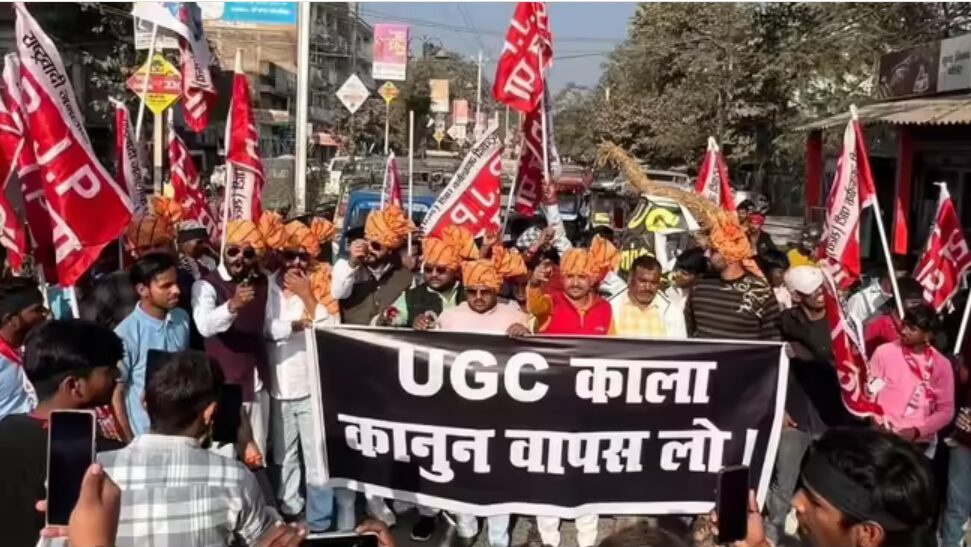
picture credit:economictimes.indiatimes.com
Equity Isn’t Discrimination:
Why Some Are Opposing the UGC Notification?
On 13th January 2026, the University Grant Commission of India (UGC) issued a notification for all the higher education institutes across India. The notification is regarding equity in higher education – University Grants Commission (Promotion of Equity in Higher Education Institutions) Regulations, 2026.
The objective of the bill states that:
“To eradicate discrimination only on the basis of religion, race, gender, place of birth, caste, or disability, particularly against the members of scheduled castes and scheduled tribes, socially and educationally backward classes, economically weaker sections, persons with disabilities, or any of them, and to promote full equity and inclusion amongst the stakeholders in higher education institutions”
This, in essence is the proposition that has triggered ‘upper caste’ protest across parts of India. Effigies of prime minister Modi are set ablaze and the education minister, Dharmendra Pradhan (yes, we do have one), subjected to public abuse.
This invites an obvious question: What exactly is so threatening about “equity” that government’s staunchest supporters are now protesting the very power they have defended over a decade.?
What the UGC 2026 Notification Actually Propose?
The objective says clearly – “to eradicate discrimination on the basis of religion, race, gender, place of birth, caste or disability”. This is universal prohibition: discrimination by anyone against anyone on these grounds is not allowed. The protection against discrimination extends to all, including the upper-caste or general category, as they like to call themselves to hide the ‘upper’ in the caste hierarchy.
The notification is an attempt to inculcate the culture of “equity” among the students in higher education and talks about equal opportunities and promoting awareness about the same in the colleges and universities. A good and timely intervention by the UGC against discrimination and promotion of equality.
However, there can be an objection to this sentence in the objective – “particularly against the members of scheduled castes and scheduled tribes, socially and educationally backward classes, economically weaker sections, persons with disabilities, or any of them.” Read carelessly this may appear exclusionary – excluding the upper caste. In reality, it reflects a long-standing assumption (fact) supported by empirical data that discrimination has affected these groups disproportionately. The emphasis here is descriptive highlighting which group has faced more systematic discrimination and in no way suggest that only this group is entitled for protection.
Read the Notification here
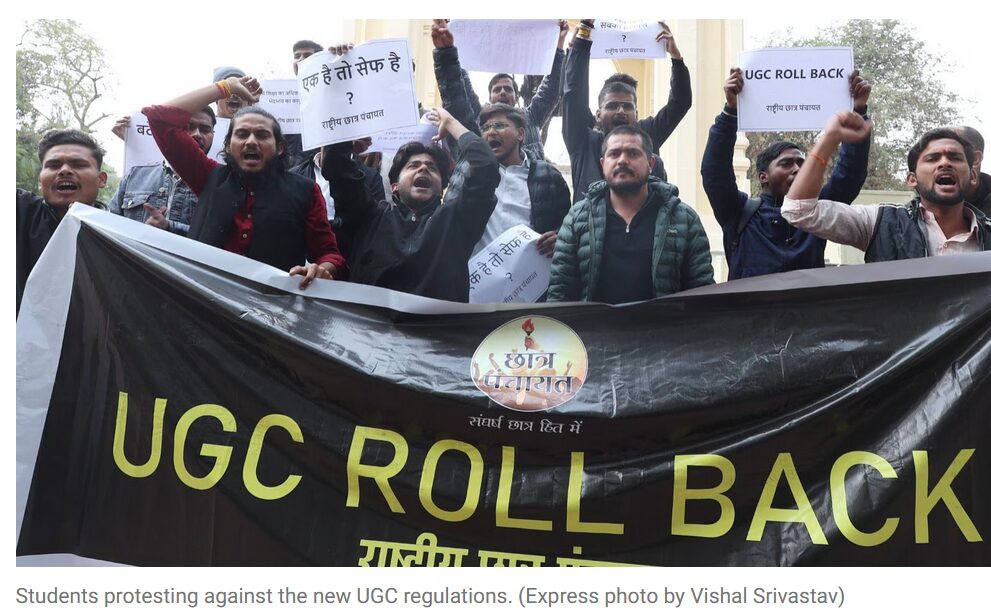
Why The Protest and Who is Protesting?
A section of upper-caste Hindus is protesting the bill, as they claim it’s exclusionary and only safeguards the SC/ST and OBCs against discrimination. If one reads the bill/notification carefully – this is not the case. It talks about promoting equal opportunity to all in higher education institutes, and includes students, faculty members, staff, and members of managing committee.
The reason for protest is that (as per the protestors) it discriminates against the “upper-caste” and the provisions of complaint and punishment documented in the bill will affect them adversely. Though after reading the notification, I am unable to find any such clause, it lists down formal process to complain, and the process of appeal against the complaint. Unlike the earlier version, the current bill does not have an option of punishment if the complaint is found false or malicious. This could be the reason of fear among some students – a complaint of discrimination can be raised against anyone without any repercussion even if the complaint turned out to be false or unsubstantiated.
Making it Hindu Upper-Caste vs Others
Hindu religious groups and student unions are calling the bill “anti – upper-caste”. A campaign to consolidate all “upper-caste” Hindus aimed at protecting their privileges and repealing the bill, is gaining momentum. It’s a textbook case of playing victim card in action. Imagine those at the very top of India’s caste hierarchy, at the top of social and religious privileges, are portraying themselves as oppressed, because a bill that promotes “equity and inclusion”. This movement (not organic in my opinion) is not only anti- UGC bill but is trying to emerge as anti-SC/ST Act and anti-reservation. In plain and simple language, the protest is against equality and inclusion.
This episode also exposes the deep hypocrisy of Indian upper-caste Hindu leadership and their supporters, who change their stance per convenience. In the last decade a large section of this group is fascinated at the possibility of the idea of Hindu Rashtra, with a supposedly Hindu government in power. In this period a lot of fringe Hindu groups mushroomed claiming to protect the “Hindu Culture” and “Sanatan Dharma”. To achieve this, they have been trying to consolidate all the Hindus with slogans like – “batenge to katenge” meaning divided we fall, “ek hain to safe hain” meaning when united we are safe. (No need to mention safe from whom).
When numerical strength is needed, caste is declared irrelevant and all Hindus are same irrespective of their caste. Yet the mask comes off the moment discussions are about equality, inclusion and reservation and caste re-enters the conversation.
Another striking hypocrisy lies in how protests are judged depending on who is protesting. Over the past decade, student movements, farmers’ protests, demonstrations against the CAA, and even gatherings such as Elgar Parishad were swiftly branded “anti-national” by large sections of the same upper-caste constituency. The media also played a central role in amplifying this narrative, repeatedly framing dissent as a threat to the nation rather than as a democratic right. The government applied its full force to crush the dissent.
Today, however, as upper-caste groups take to the streets demanding the rollback of a UGC notification, the response is restrained both by the government and the media. Effigies of the Prime Minister are burned, ministers are openly abused, and yet the familiar labels of “anti-national” are nowhere, no police crackdown, and no outrage on the news channels (most are sympathetic to the protestors). Even the judicial intervention is swift and in favour of the protestors, with supreme court staying the UGC regulations on the grounds that, “It will lead to very dangerous Impacts”. The contrast is hard to miss, dissent is dangerous when it comes from the margins and is treated as legitimate concern if it comes from the privileged.
What the Data Tells
If we look from the perspective of equality, inclusion and representation in higher education, the data is not very encouraging. The high dropout rate among the students, the vacant positions (reserved for SC/ST/OBCs) in college and universities points to a certain direction. There may be multiple for this, but discrimination remains one of them – A dark reality that surfaces repeatedly in reports, testimonies and public discourse.
I am attaching a link to one such news report, just to give an idea.
There is no denying that discrimination still exists against SC/ST/OBCs and religious minorities. If the UGC issues a guideline/notification to address it and to pave way for a more equal and inclusive higher education, I am left with a simple question – why would anyone object?
FInally
The UGC regulations appear to be drafted with (un)clear and constructive intent – to make the higher education equal and inclusive for everyone – students, professors, and staff alike. The UGC’s objective should be welcomed. At the same time, a close reading of the bill/notification makes me feel that there are some ambiguities and they could have articulated more clearly and explicitly.
What is unwarranted is the needless fear-mongering on part of some groups. The regulations are not directed against any group, least of all the upper-caste. Much of all the social media outrage is either due to complete lack of understanding, misunderstanding or deliberate misrepresentation of the intent.
In reality, the needless controversy has become yet another tool at the hands of Hindutva groups and their supporters. The aim is not a genuine concern for higher education or making campuses to be more equal and inclusive, but to consolidate opposition against SC/ST Act and caste-based reservations. Beyond that there is little substance to the protest.
About the Author

Manoj Payal
Manoj is an avid reader, writer in progress, and reviewer with interests in literature, history, politics, and the social sciences. With over two decades in the IT industry, he brings analytical depth to book reviews, essays, articles, and poetry that explore ideas and human experiences.