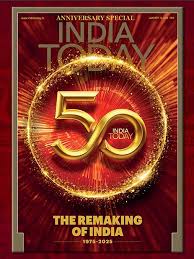
picture credit:brandsandentertainment
India Today at 50:
From Proud Interrogator to Comfortable Spectator
Growing up with a Magazine
I remember cycling to Cambridge Book Store near the railway underbridge in one of the newly opened shopping malls to get the latest copy of India Today. The shopkeeper, who knew me well as I was a frequent visitor, told me that the latest issue had not arrived yet due to some delays. Too eager to wait another day or two, I cycled to the railway station and checked the A.H. Wheeler bookstalls. It was a very familiar sight on Indian railway stations during the 1990s. Wheeler’s was the place where one could find all kinds of magazines in those days. I am not sure how many of these stalls exist today, but back then Wheeler’s was reliable. I finally found my copy of India Today there.
When I was in high school and later in college, India Today magazine was a regular at my home. I was proud of the fact that I read India Today. It may sound childish now, but when guests visited our home, I used to place the magazines on the living room table, even though they usually stayed in my room. The brand carried value, and its readers were held in high regard. India Today had earned respect as a trusted publication that raised pertinent questions and published reports that concerned citizens.
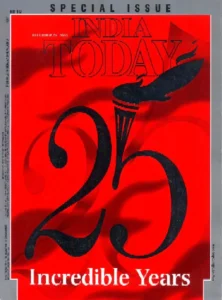
India Today released its first edition in December 1975—the year the Emergency was imposed by Indira Gandhi. On its 25th anniversary (year 2000), a letter from the editor-in-chief, Arun Purie, was published in the magazine, reflecting on its birth and journey. Here is a short excerpt from what he wrote:
I’m often asked: what’s the secret of the success? I don’t have a specific answer. I know it is not just one factor but a combination of many. Perhaps it’s the fanatical belief that what matters in a publication is editorial excellence and credibility. Spend all your resources on getting it right and the rest of the financial equation will work itself out. For better or worse, we are an editorially driven media organization as against a marketing one. – Arun Purie
India Today in the Media Ecosystem
I believe India Today maintained its editorial excellence and credibility during those years. This was also a period when satellite television entered India, and several business houses ventured into the television media space. Most major print players entered television, along with some new entrants.
People now had more options for consuming news and information. Many migrated to television because it was faster. India Today also launched its news channel, Aaj Tak.
However, for readers accustomed to detailed reports with in-depth analysis and proper context, print media—especially magazines, remained the preferred choice, even if they also watched television news.
Some cover stories of India Today from the 90s and and early decade of 2000s.
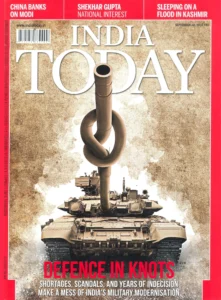
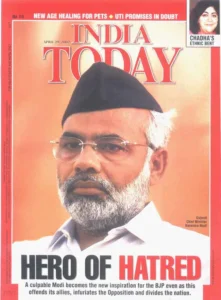
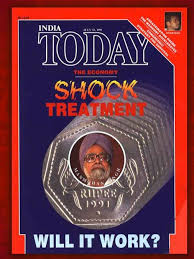
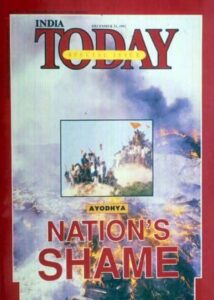
India Today remained a well-respected brand through the late 1990s and the first decade and a half of the 21st century. I can vouch for its brand value from personal experience. After graduation, I worked in Delhi for an industrial directory published by a sister concern of the India Today Group. Simply invoking the name, “we are calling from India Today”, was often enough to secure appointments and access to business houses. That level of credibility came from years of trust and editorial integrity.
As more readers migrated from print to television and digital media, the media’s focus inevitably shifted. News was no longer just about reporting; it became about viewership and Television Rating Points (TRPs), which translated directly into advertising revenue. To retain audiences, channels were required to provide 24×7 news—an impossible task if one relied solely on serious journalism.
When Journalism Changed
Inevitably, entertainment and shallow reporting crept in. “News” shows began making space for godmen, astrology, ghosts, and spectacles of every kind all designed to hold viewers’ attention and boost ratings. This diluted television journalism across the board, barring a few exceptions.In the process, a new breed of television audience emerged—one that wanted information quickly, without much detail or concern for nuance and verification. The priority was to be updated at the earliest, not necessarily to be well informed. In this environment, space for long-form magazine reporting began to shrink.
As television and radio networks expanded steadily, magazines in general stopped growing, and India Today was no exception. It continued to enjoy a loyal readership, but the larger audience was clearly drifting toward television and later to digital platforms.
Another major shift I have witnessed over the last decade is the near-complete surrender of mainstream media to the government. There is no single cause for this, but rather a convergence of structural pressures—advertising leverage, ownership economics, regulatory pressure, fear and self-censorship, and pro-government alignment.
Together, these factors have played a significant role in diluting journalism in India. This is the reason most pro-government media houses are now referred to as “Godi Media” (puppet media), reflecting their submissive approach and reluctance to question authority. The deterioration of journalism is evident in India’s continuous fall in global press freedom rankings over the past decade.
I am a witness to this degradation of mainstream media be it print, television, or digital. Watch any news channel or read any newspaper, and you will often find anchors and editors defending the government rather than questioning it. This is especially prominent on television, where many anchors have become government spokespersons, running debates designed to protect those in power.
This pattern is visible across a range of major events—COVID deaths, demonetization hardships, GST implementation pains, stampedes, train accidents, riots, and corruption cases. While these incidents are reported, the framing often shields the government from accountability. Some anchors have become so partisan and pliant that it is embarrassing to even watch them.
Television, being a visual medium, makes it easier to spot these “puppets” putting on a show and calling it news. In long-form magazines, the shift is subtler but equally real. Even print media has increasingly become a tool for soft government propaganda. This is evident in cover designs, story selection, and omissions. Government leaders are often featured with positive imagery and language, while opposition figures are framed more critically. Unfortunately, even India Today has not been immune to this decline.
I cherished India Today for its fearless reporting until my confidence in the magazine began to erode a few years ago. It once asked tough questions and offered in-depth coverage of national issues. It is deeply disheartening to see that, at fifty, the magazine has chosen to become a compliant partner to the government rather than a true voice for citizens.
Any hope for television news channels had faded long ago. They began to sound like government spokespersons, with their primary role reduced to defending the government and sowing seeds of division. Division, after all, is a tool used by the state to distract citizens from governance by keeping them busy with trivial and irrelevant issues. News channels perform this role efficiently, serving hate and bigotry every night during prime time. Television, catering to the masses with no real checks and balances, has contributed to creating an army of dumbed-down citizens.
The Anniversary and What it means
Magazines, on the other hand, cater to a relatively more intellectual audience—people who like to read, think, and analyze. The transformation there, from accountability-seeking journalism to soft peddling of government propaganda has been subtle. Headlines, language, and story selection have been carefully calibrated, including decisions on which stories to exclude entirely.
I am reminded of the frog-in-boiling-water analogy. “If a frog is placed in boiling water, it jumps out immediately. But if placed in cold water that is gradually heated, it fails to notice the danger and is boiled alive.” This is what respected print media (magazines and newspapers alike) have been doing for years. Gradually, they have changed vocabulary and normalized terms once considered unacceptable. Independent assessments now show that India Today carries a right-center bias, a shift from its earlier stance.
Terms like “Tukde-Tukde Gang,” “Urban Naxals,” “pseudo-secular,” “UPSC jihad,” and “love jihad” are now common in television discourse, with Aaj Tak leading in normalizing them. But when the print media, especially magazines use these terms—even in quotation, it lends them legitimacy.
This normalization aligns with the India Today magazine’s reporting approach. Try to recall: did the magazine aggressively pursue stories on the alleged Rafale scam, the PM CARES Fund, or COVID deaths? Reports existed, but direct questioning of the government, let alone the Prime Minister was completely absent. On the surface, coverage may appear consistent, but for long-time readers, the shift is unmistakable. The framing, language, and story choices reflect a cautious, submissive approach—a far cry from the fearless questioning that once defined the brand.
Covers in the recent years- can you spot something?
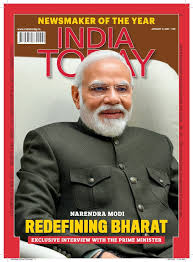
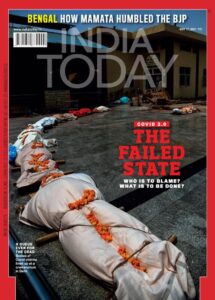
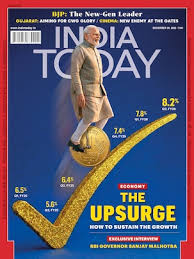
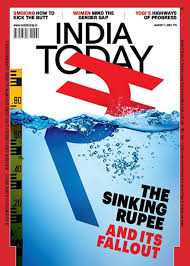
It is disappointing to see my childhood magazine, once fearless in asking tough questions, holding power accountable, and reporting on issues that mattered, reduced to a shadow of its former self on its fiftieth anniversary.
The words from the editor-in-chief of India Today, Arun Purie on the 50th anniversary of the magazine.
We will continue to chronicle India in the present tense and with the same rigour, curiosity, integrity and passion for editorial excellence. That is the leitmotif of INDIA TODAY and the larger India Today Group. It has guided us for 50 years, and it will guide us still. India is a restless, aspirational, argumentative, inventive, democratic nation with a life-force of its own. It is a pleasure and a privilege to hold a mirror to it. Happy 50th anniversary.
Reading these words today, I cannot help but feel the gap between the ideal and the reality. While Arun Purie’s vision is inspiring, for someone who grew up with the magazine, it is difficult not to feel a sense of loss and longing for the fearless reporting that once defined it. I leave it to the reader to ponder whether the magazine still holds that mirror to the nation, or if it has softened, aligning itself with the powers to be.
About the Author

Manoj Payal
Manoj is an avid reader, writer in progress, and reviewer with interests in literature, history, politics, and the social sciences. With over two decades in the IT industry, he brings analytical depth to book reviews, essays, articles, and poetry that explore ideas and human experiences.