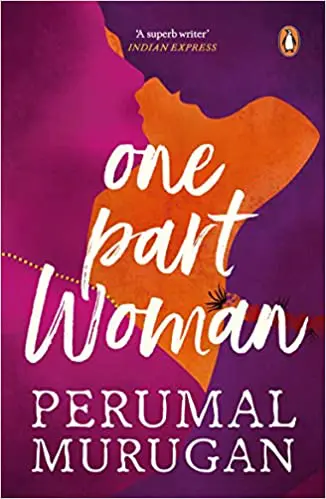
One Part Woman by Perumal Murugan is a powerful Tamil novel about marriage, childlessness, social pressure, caste, faith, and the emotional life of a couple named Kali and Ponna. This review looks at the novel’s summary, major themes, writing style, and why the book remains one of Murugan’s most discussed works.
Book: One Part Woman
Author: Perumal Murugan
Original title: Madhorubhagan
Translator: Aniruddhan Vasudevan
Form: Literary fiction / translated Tamil novel
Main themes: Marriage, childlessness, social stigma, caste, faith, desire
Best for: Readers interested in Indian literary fiction, rural Tamil Nadu, gender, caste, and social pressure
Why I Picked One Part Woman
Perumal Murugan is a writer I am always interested in reading. I had earlier read Poonachi: Or The Story of a Black Goat and Estuary, and both books stayed with me in different ways. Since One Part Woman is one of his most famous and widely respected works, it felt like the natural next book to pick up.
What Is One Part Woman About?
One Part Woman is the English translation of Perumal Murugan’s Tamil novel Madhorubhagan, translated by Aniruddhan Vasudevan. Madhorubhagan in Tamil means half male, half female or Ardhanareeswara, as Lord Shiva is called in Sanskrit. The story is about a childless couple, Kali and Ponna, living in a village in Tamil Nadu. It captures the taunts and humiliation they face simply because they do not have a child. Set in the pre-Independence era, the novel takes readers through village customs, traditions, and social values, showing how failing to conform could make a person an object of ridicule or even an outcast.
Readers interested in how caste shapes Indian society may also find this list of books that explore caste in India useful.
Kali and Ponna have been married for twelve years and are very much in love with each other. Kali lives in a village with her mother and Ponna. In the village, having a child is a matter of pride and good luck. When, after a year of marriage, they did not conceive, people suggested various things to the couple, and especially to Ponna. Following these suggestions, they visit many shrines, pray to their local deity, and try several remedies advised by family, relatives, and villagers. One of the medications included drinking “neem leaves” juice, which Ponna hated. They followed everything suggested to them, but still, Ponna was not able to conceive. People started gossiping about them and started making fun of Kali saying he might be impotent. Kali started to withdraw from his friend circle and became a recluse. Their families even suggested a second marriage for Kali, but he refused.
The humiliation she had had to suffer because of this one problem was endless. She could not even go to their own fields during the sowing season for fear that others would broach the topic. So she would lock herself inside the house.
Despite not having a child, they loved each other very much. Ponna sometimes felt guilty that she was not able to provide a child to Kali. Having a child, especially a son, was treated as a matter of pride and status among the villagers. Childless couples were seen as unlucky, as though they were paying for the sins of their ancestors. Perumal Murugan, the master storyteller, brings to life a village from the pre-independence era. He paints a picture of the village so beautifully that you visualize it. Along with that, he captures the nuances of village life — its traditions, rituals, beliefs, and their effect on Kali and Ponna.
Kali’s and Ponna’s mothers decide to send Ponna to the temple festival of Madhorubhagan, hoping that an old ritual associated with the festival may finally give the couple a child. The novel then moves toward a painful question: how far can longing, social pressure, and family expectations push a loving couple? These are some of the answers you will find once you read the book.
Perumal Murugan’s Writing Style
Perumal Murugan’s writing in One Part Woman is simple, earthy, and deeply rooted in village life. He does not over-explain emotions; instead, he lets small gestures, silences, rituals, and everyday conversations reveal the pain between Kali and Ponna. The language feels restrained, but the effect is quietly disturbing, especially as social pressure and superstition slowly tighten around the couple.
Who Should Read One Part Woman?
One Part Woman is strongly recommended for readers who enjoy serious literary fiction rooted in society, culture, and human relationships. It is especially worth reading for those interested in rural Tamil Nadu, marriage, childlessness, social stigma, gender expectations, and the quiet violence of caste and tradition. The novel is not always comfortable to read, but that is exactly where its power lies.
One Part Woman is storytelling at its best. It takes the reader through love, humiliation, longing, and social pressure without ever losing sight of Kali and Ponna as human beings. Readers interested in literary fiction and rural Indian society will find it especially worthwhile.
About Perumal Murugan and Aniruddhan Vasudevan
Perumal Murugan is the star of contemporary Tamil literature. An award-winning writer, poet, and scholar, he has garnered both critical acclaim and commercial success for his vast array of work. Some of his novels have been translated into English to immense acclaim, including Seasons of the Palm, which was shortlisted for the Kiriyama Prize in 2005, and One Part Woman, his best-known work, which was shortlisted for the Crossword Award and won the prestigious ILF Samanvay Bhasha Samman in 2015.
Aniruddhan Vasudevan is a performer, writer, translator, and PhD student in anthropology at the University of Texas, Austin. His much-lauded translation of Perumal Murugan’s One Part Woman has become an award-winning bestseller. He has also translated other works by Perumal Murugan to wide acclaim, including Pyre and Songs of a Coward: Poems of Exile.
By the Same Author
About the reviewer

Manoj Payal
Manoj is an avid reader and a writer in progress, with interests spanning literature, history, politics, and the social sciences. His writing across book reviews, essays, articles, and poetry—explores ideas, society, and the human experience.He has spent over two decades working in the IT industry, a background that informs his analytical approach to reading and writing.