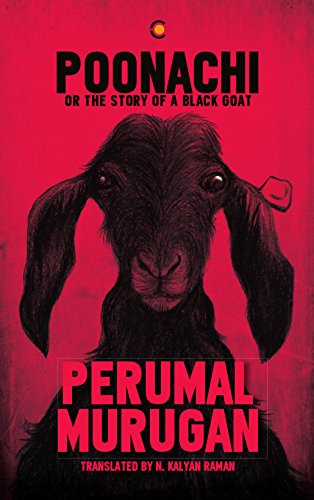
Poonachi: Or the Story of a Black Goat by Perumal Murugan is a deceptively simple story about a small black goat struggling to survive in rural Tamil Nadu. Translated from Tamil by N. Kalyan Raman, the novel follows Poonachi from birth to death, but beneath the story of an animal lies a powerful commentary on human society. Through her life, Murugan explores survival, gender, inequality, oppression and the relationship between ordinary people and those who exercise power over them.
Book: Poonachi: Or the Story of a Black Goat
Author: Perumal Murugan
Translator: N. Kalyan Raman
Original language: Tamil
Genre: Literary Fiction / Allegorical Fiction
English edition: 2018
Publisher: Westland / Context
Setting: Rural Tamil Nadu
Key themes: Survival, gender, oppression, inequality, power and rural life
Best for: Readers of Indian literary fiction, translated literature and socially conscious fiction
Why I Picked Poonachi
It’s funny how sometimes a book cover or a title simply calls out to you. That’s exactly what happened with Poonachi: Or the Story of a Black Goat. The title intrigued me, and I decided to give it a try. I read the first paragraph of the preface and instantly knew that this was going to be an unusual and thought-provoking read.
How long can an untold story rest in deep slumber within the dormant seed? I am fearful of writing about humans, even more fearful of writing about gods. I can write about demons, perhaps. Yes, let me write about animals.
That was enough for me to take the plunge. And I’m glad I did.
About Poonachi
Poonachi is the story of a small and weak black goat gifted by a mysterious man to an old farmer. The farmer and his wife, though poor and struggling themselves, raise her with care. The old woman names her Poonachi, after a kitten she once loved.
What follows is Poonachi’s journey of survival against the odds—her struggle as a goat who is different from the rest, her place within the herd, and her relationships with her owners and other goats. Told largely through Poonachi’s perspective, it is a life story that begins with birth and ends with death. In between, Murugan captures village life, human behaviour and the everyday struggle for survival with remarkable simplicity.
But Poonachi is much more than a goat’s tale. Murugan uses her life to reflect on human society, particularly the condition of women—the restrictions placed upon them, the discrimination they face and their struggle to survive within systems over which they have little control. There is also sharp political and social commentary woven into the story, often delivered with understated humour.
Speak softly, sir. The regime has ears on all sides. There’s an old saying that the regime is deaf. It’s deaf only when we speak about our problems. When we talk about the regime, its ears are quite sharp.
The life of an animal gradually becomes a metaphor for the lives of ordinary people. Questions of freedom, surveillance, authority, gender and survival emerge without turning the novel into an overt political lecture. That, for me, is one of the strengths of the book.
Writing Style
Murugan writes with a quiet rhythm, allowing moments to breathe. The pace feels much like the village life he describes—slow but steady, never rushed. There is a deceptive simplicity to the writing: what appears to be a straightforward story about a goat gradually reveals deeper layers of social and political commentary.
The translation by N. Kalyan Raman deserves special mention for retaining the earthy feel and subtle emotions of the original Tamil. Despite the simplicity of the language, Murugan is able to make Poonachi’s fears, desires, suffering and moments of happiness feel remarkably human.
Who Should Read Poonachi
Poonachi will appeal to readers who enjoy simple stories with deeper meanings beneath the surface. It is particularly suited to readers of Indian literary fiction, translated literature and books that use ordinary lives to explore larger social and political questions. You do not have to be interested in rural life or even stories about animals to connect with Poonachi; her experiences of fear, love, loss, survival and the desire for freedom are remarkably human.
The book moves at a gentle pace, so readers looking for a fast-moving, plot-driven novel may find it slow. But if you enjoy quiet, thoughtful fiction that allows you to read between the lines, Poonachi has a great deal to offer. What appears to be a simple story about a black goat ultimately becomes a story about the lives we often overlook—and that is what makes the book stay with you.
About the author
Perumal Murugan is the author of eight novels, four collections of short stories and four anthologies of poetry in Tamil. Poonachi has been translated into five Indian languages. Its English translation was shortlisted for the JCB Prize for Literature and longlisted for the National Book Award in the United States of America.
About the Translator
N Kalyan Raman is a translator of contemporary Tamil fiction and poetry into English. Over the past twenty-five years, he has published fourteen volumes of Tamil fiction in translation, by important writers such as Ashokamitran, Devibharati Poomani, Perumal Murugan, Vaasanthi and Salma. His translations of contemporary Tamil poets have been published widely in journals and anthologies in India and abroad.
By The Same Author

About the reviewer

Manoj Payal
Manoj is an avid reader and a writer in progress, with interests spanning literature, history, politics, and the social sciences. His writing across book reviews, essays, articles, and poetry—explores ideas, society, and the human experience.He has spent over two decades working in the IT industry, a background that informs his analytical approach to reading and writing.