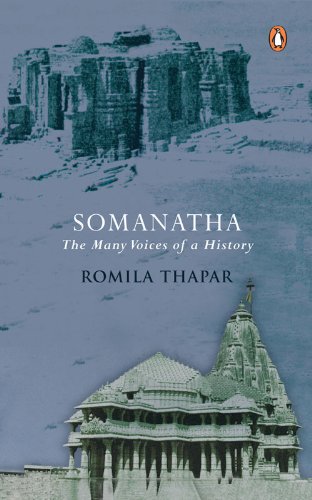
The attack on Somnath temple by Mahmud of Ghazni, in 1026 CE, is often cited as a defining moment in Indian history – a symbol of religious conflict, a clash between invading Muslims and Hindu civilization. In Somanatha – The Many Voices of History, renowned historian Romila Thapar invites us not simply to hear this story but to listen to the multitude of voices that surround it. The result is an engaging, meticulously researched work that challenges conventional narratives by putting together diverse sources and perspectives to reconstruct a more nuanced history.
The book considers multiple historical sources available and the context in which they are written. She presents the Turko-Persian chronicles along with local Sanskrit inscriptions, Jain biographies, merchant accounts, and popular narratives that have survived in different parts of India. These voices, often overlooked in conventional histories of Somnath, offer alternative frameworks for understanding the event and its implications.
While reading the book and the various sources it has gathered it becomes clear that mostly the Turko-Persian or “Muslim” sources have captured the destruction of the temple in detail and sometime even boasting about it. Yet, significantly, even these sources also do not provide a single unified narrative. Their narratives vary in detail, emphasis and motivation. Some sources frame the raids in explicitly religious terms, while others document them as political ambition, military success, or the loot of wealth.
What is interesting to note, as per the book is the relative absence of the raids in the contemporary Sanskrit sources. Temple inscriptions, local records, and literary texts from the region do not talk about the raids on the temple with same intensity and do not present it as some civilizational rapture. The book argues if the destruction was such a catastrophic event that later generations made it out to be, one would expect widespread references to it in local records and inscriptions. Yet, the various sources talk about the temple and its traditions without capturing the destruction and plunder of the temple.
The first invasion of Somnath a thousand years ago in 1026, the cruelty that was unleashed upon the people of the town and the devastation that was inflicted upon the shrine have been documented in great detail in various historical accounts. When you read them, the heart trembles. Each line carries the weight of grief, cruelty and a sorrow that refuses to fade with time. – PM Modi, January 2026
The various historical account mentioned by the PM are mostly Turko-Persian accounts as per the Book. These accounts were picked up by the British colonial histories, who turned them into foundational trauma of Hindu identity and Muslim invader using it as strategy of “divide and rule”. This narrative was further appropriated by Hindu nationalist and became a part of their politics continuing to the present.
The book does not dismiss the importance of the raid on the temple; it shows us how the meaning and symbolism has shifted over time. This historical layering invites readers to reflect on how collective memory is constructed, and how events of the distant past can be reshaped to serve present-day ideologies. It urges to read, analyze and review history without any binaries of invaders vs victim, Muslim vs Hindu, outsiders vs inhabitant, but as a whole – understanding the context, circumstances, and politics of that time.
For readers accustomed to straightforward narratives of conquest and conflict, Somnatha may feel a difficult read, as I experienced myself. There are lot of sources and their analysis, which makes it deep and demanding read. Yet, this depth is what makes the book valuable. The book is less about setting the record straight for once and all, but about encouraging critical engagement with historical sources and assumptions. Beyond the specific focus on Somnath, the book tells us how history should be approached in a pluralistic society.
Finally, Somanatha – The Many Voices of History reminds us that history is not a monologue, but a chorus and understanding it requires to listen to all the voices carefully- not just the loudest or the most familiar. A great read for anyone who is interested in Indian history and the politics of historical interpretation.
About the author
By the Same Author

About the reviewer
Manoj Payal
Manoj is an avid reader and a writer in progress, with interests spanning literature, history, politics, and the social sciences. His writing across book reviews, essays, articles, and poetry—explores ideas, society, and the human experience.He has spent over two decades working in the IT industry, a background that informs his analytical approach to reading and writing.