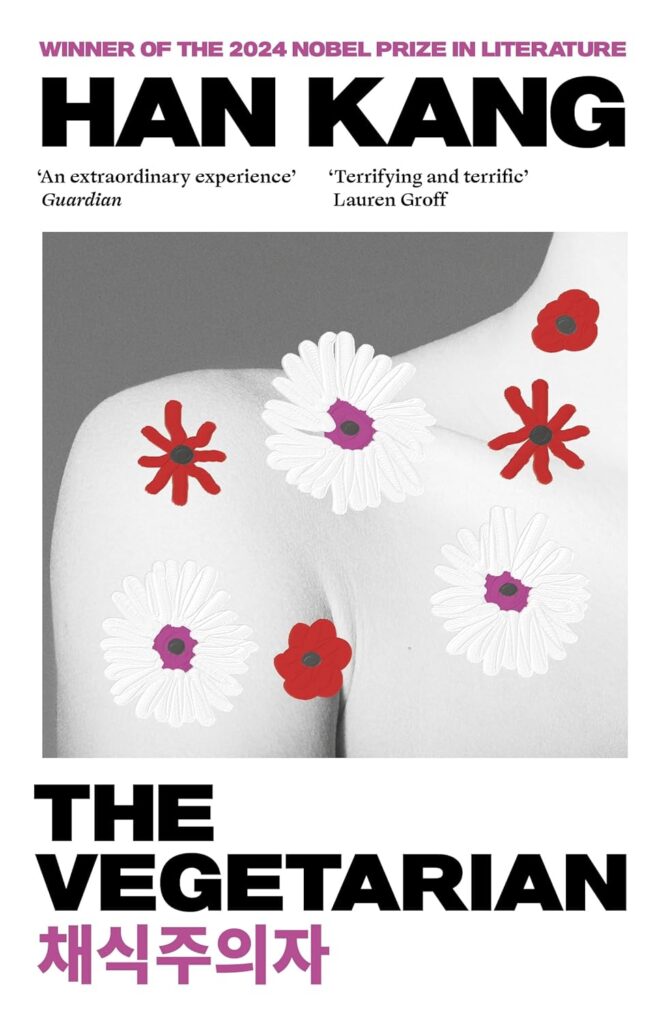
The Vegetarian by Han Kang is about a woman who gives up eating meat and becomes a vegetarian. The novel offers readers a glimpse into South Korean society, where meat occupies a central place in food culture. Yeong-hye’s decision is not taken kindly by her family, who view it as an act of defiance rather than choice. At a family gathering, she is forcibly made to eat meat. Disgusted and enraged by the violation, she later slits her wrist in an attempt to kill herself.
Although the novel revolves around Yeong-hye, her story is told through the perspectives of those around her, her husband, her brother-in-law, and her sister (In-hye).
The first part of the novel is narrated by Mr. Cheong, Yeong-hye’s husband, who is unable to comprehend why his wife has suddenly turned vegetarian. He is a deeply patriarchal man who describes Yeong-hye as entirely “unremarkable,” and therefore expects her to be obedient and dutiful. Her abrupt refusal to eat meat becomes a point of constant conflict, leading to emotional abuse and eventually divorce. When pressed for an explanation, Yeong-hye speaks only of her dreams—violent dreams filled with blood. Mr. Cheong cannot tolerate the fact that his wife is becoming someone else, someone who defies his wishes and, by extension, his control.
The second part of the novel shifts to the perspective of Yeong-hye’s brother-in-law, a struggling video artist married to her elder sister, In-hye. He is financially dependent on his wife, who is both the primary breadwinner and the caretaker of their son. His fixation on Yeong-hye begins when he learns—through his wife—that she has a Mongolian mark on her body. After Yeong-hye is discharged from the hospital and divorced by Mr. Cheong, the brother-in-law persuades her to pose nude for his art project, painting flowers on her body and filming her. His artistic obsession soon turns sexual, and he eventually has sex with Yeong-hye. The disturbing part is not the sexual transgression but the way Yeong-hye mental condition, her silence and vulnerability is taken as consent.
They are discovered by In-hye, who is devastated. She calls a mental institution, and both Yeong-hye and her husband are institutionalized. The brother-in-law attempts suicide but survives; after his release, he fades into obscurity, removed from their lives.
The third part of the novel is narrated by the sister, In-hye. She takes care of Yeong-hye, who is now hospitalized and deteriorating rapidly. Yeong-hye has not only given up meat but has stopped eating altogether. The hospital force-feeds her to keep her alive. In-hye is the only one who remains by her sister’s side, watching her slowly waste away while carrying the burden of care and responsibility alone.
The novel subtly portrays the rigid structure of the South Korean family, marked by strict patriarchal control and expectations of submission and compliance. Yeong-hye is the only one who refuses to yield, and she pays a terrible price for that defiance.
While the story progresses smoothly and is beautifully written, I struggled to fully grasp certain elements—particularly the symbolism of Yeong-hye’s dreams and the brother-in-law’s fantasies. These aspects felt opaque and unresolved. I found myself searching for clarity or moral resolution, but none was offered. Perhaps this ambiguity is intentional. Yeong-hye cannot be understood because she refuses to explain herself, and that refusal itself becomes an act of resistance.
The Vegetarian was a challenging read for me. At its core, the novel is not about food, sexuality, or mental illness. It is about what happens to a woman who says no in a world that expects her to comply. The novel suggests that the cost of resistance is devastating—but so is compliance
About the author
Han Kang was born in 1970 in South Korea. In 1993 she made her literary debut as a poet and published her first short story in 1994. She won the Man Booker International Prize for The Vegetarian and was shortlisted for The White Book. In 2024, Han Kang was awarded the Nobel Prize in Literature ‘for her intense poetic prose that confronts historical traumas and exposes the fragility of human life’.
By the Same Author
About the reviewer
Manoj Payal
Manoj is an avid reader and a writer in progress, with interests spanning literature, history, politics, and the social sciences. His writing across book reviews, essays, articles, and poetry—explores ideas, society, and the human experience.He has spent over two decades working in the IT industry, a background that informs his analytical approach to reading and writing.