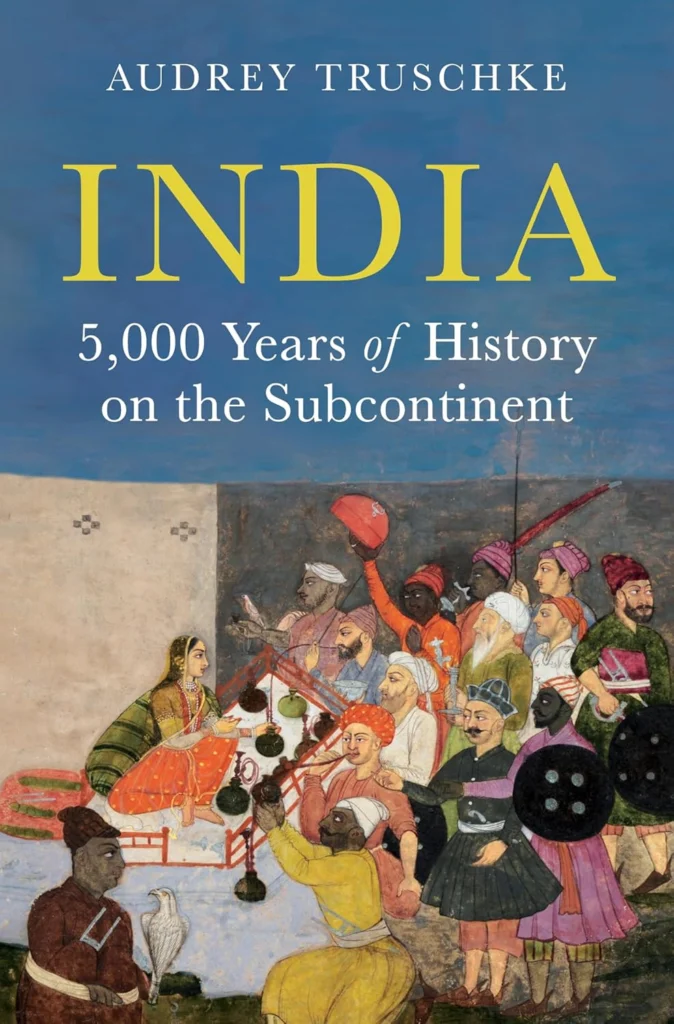
India: 5,000 Years of History on the Subcontinent by Audrey Truschke is a broad and accessible account of Indian history, from the Indus Valley Civilization to modern India. The book looks at major historical periods, political myths, social reform, caste, women’s histories, religion, empire, partition, and the making of the modern subcontinent. This review looks at how the book helps readers question familiar narratives and approach India’s past through a wider historical lens.
Book: India: 5,000 Years of History on the Subcontinent
Author: Audrey Truschke
Form: History / Indian non-fiction
Subject: A broad history of the Indian subcontinent from ancient times to modern India
Main themes: Indian history, political myths, religion, caste, women reformers, temple destruction, Mughal history, independence, partition, and social reform
Best for: Readers interested in Indian history, social reform, political narratives, caste, women’s history, and broad historical overviews
Why Did I pick - India: 5,000 Years of History on the Subcontinent
I enjoy reading history, especially Indian history. In recent times, however, there has been a growing attempt to rewrite history to suit certain ideological narratives. In the process, the line between history and mythology—or even fabricated history—often begins to blur. When India: 5,000 Years of History on the Subcontinent by Audrey Truschke was published, I decided to read it to understand India’s past from the perspective of a historian who might approach the subject with academic distance rather than emotional or ideological attachment.
What India – 5000 Years of History on the Subcontinent Covers
As the title suggests, the book attempts to cover nearly five thousand years of the history of the Indian subcontinent—from the Indus Valley Civilization to the present day. It traces, in broad strokes, how the region evolved into what we recognize today as the Indian subcontinent. Truschke begins with the Indus Valley Civilization, which flourished for roughly seven centuries (2600–1900 BCE) before gradually declining and eventually disappearing. From there, she moves through Vedic India, the rise of powerful kingdoms, and the empire of Ashoka. Along the way, the author draws on the accounts of various travellers who visited the subcontinent at different points in history, using their observations to illuminate the societies they encountered.
Through the lives of rulers and the experiences of ordinary people, the reader is introduced to several important periods of Indian history. The book also examines the influence of different cultures and religions that came to the subcontinent—some through trade and others through conquest. Importantly, Truschke also brings attention to the southern dynasties and kingdoms that are often overlooked or only briefly discussed in conventional historical narratives. In doing so, the book challenges several widely held assumptions about historical events and encourages readers to reconsider what they think they know about India’s past.
The book also presents several interesting discussions on subjects such as the Mahabharata, the arrival of Muslims and Christians in India, and the complex history surrounding temple destruction. While temple destruction is often popularly portrayed as an act of religious bigotry, the author argues that both Hindu and Muslim rulers engaged in such acts, frequently for political and economic reasons—to display power or capture wealth—rather than purely out of religious hostility. In a similar manner, the book addresses many of the myths surrounding Mughal rulers that have gained prominence in contemporary political discourse.
Another aspect I particularly appreciated was the way the author incorporates perspectives that are often marginalized in traditional histories. She highlights the contributions of women and Dalit reformers, bringing attention to figures such as Savitribai Phule, Pandita Ramabai, Anandibai Joshi, and Rukhmabai, whose work played a significant role in shaping the future of women’s rights and social reform in India.
Readers interested in the social hierarchies that shaped Indian history may also find this list of books that explore caste in India useful.
Although these events and debates are documented in historical records, we rarely encounter detailed discussions about these women or how the prominent leaders of their time responded to their views. The book brings some of these perspectives to light. One striking example is Bal Gangadhar Tilak’s view on women’s autonomy. In 1888, writing in Kesari, a Marathi newspaper he owned, Tilak expressed the following opinion:
“If a Hindu husband sees his disobedient wife walking on the street or entering some house, he may drag her home or enter a stranger’s house to bring her home; in neither case he is liable to a lawsuit according to Hindu religion… A man who finds his cow wandering about and puts a rope around her neck and brings her home is not liable to a lawsuit according to English law. The Hindu religion considers a woman to be on par with property and cattle. The only distinction is that as a human being she is entitled to food and clothing.”
This statement was a part of editorial debate made in the context of the debates surrounding the Rukhmabai case. Rukhmabai had been married as a child but, after reaching adulthood, refused to live with her husband. In response, her husband filed a legal suit seeking restitution of conjugal rights.
Moments like these reveal the social attitudes of the time and remind the reader how deeply entrenched certain ideas about women were in nineteenth-century society.
The book also covers India’s independence movement, highlighting the roles and contributions of various freedom fighters. It goes on to discuss the partition of India into two nations and briefly examines how the newly independent countries began the task of building their respective states.
Writing Style
I particularly appreciated the book’s writing style, which follows a chronological structure. This allows readers to see how historical developments unfolded over time. The book is divided into twenty-four chapters, making it manageable despite its length of nearly five hundred pages. One can easily read a chapter or two at a time and return to it later without losing the thread of the narrative.
Another useful feature is that the book provides a broad overview of many historical subjects, encouraging readers to explore particular topics further if they find them interesting. At the end of each chapter, the author includes suggestions for further reading, which can be especially helpful for anyone who wishes to study certain themes in greater depth.
Who Should Read
This book is useful for readers who want a broad overview of Indian history rather than a deep study of one particular period. It is especially helpful for those interested in how political narratives, religious myths, caste, gender, reform movements, and historical memory shape the way India’s past is understood today.
Readers who enjoy history but do not want an overly academic or difficult book may also find it accessible. Since the book covers nearly five thousand years in one volume, it works best as a starting point that encourages further reading.
our Verdict
Overall, India – 5000 Years of History on the Subcontinent offers a broad and accessible overview of the long and complex history of the Indian subcontinent. Covering such a vast span of time in a single volume is no easy task, yet Audrey Truschke manages to present key developments, debates, and historical figures in a manner that is both engaging and informative. The book encourages readers to question commonly held assumptions and to look at history through a wider and more critical lens.
Since the book covers nearly five thousand years in a single volume, it cannot go deeply into every period or debate. Its strength lies in offering a wide historical overview and encouraging readers to explore specific subjects further.
For readers interested in Indian history, political myths, social reform, and the long historical roots of present-day debates, this book serves as a useful and thought-provoking starting point.
About the Author
Audrey Truschke is professor of South Asian history at Rutgers University, Newark. She is the bestselling author of Aurangzeb: The Life and Legacy of India’s Most Controversial King and other books. She received her Ph.D. in 2012 from Columbia University. Her research focuses on the cultural, imperial, and intellectual history of early modern and modern India (c. 1200-present).
Related Readings
If India: 5,000 Years of History on the Subcontinent interests you, then these related reviews will help you explore more books on Indian history.
About the reviewer
Manoj Payal
Manoj is an avid reader and a writer in progress, with interests spanning literature, history, politics, and the social sciences. His writing across book reviews, essays, articles, and poetry—explores ideas, society, and the human experience.He has spent over two decades working in the IT industry, a background that informs his analytical approach to reading and writing.