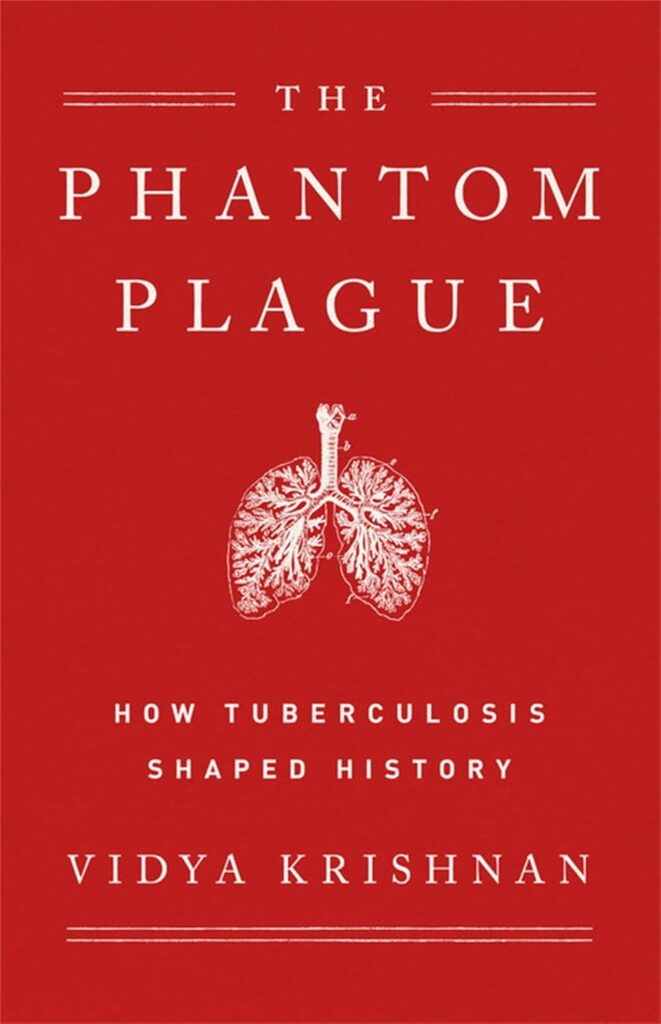
The Phantom Plague: How Tuberculosis Shaped History by Vidya Krishnan is a powerful book about tuberculosis, its history, its stigma, and the public-health failures that continue to make it dangerous. The book moves from the early confusion around disease and contagion to the modern crisis of drug-resistant TB, showing how poverty, inequality, patriarchy, pharma patents, and government inaction shape who gets treated and who gets left behind.
Book: The Phantom Plague: How Tuberculosis Shaped History
Author: Vidya Krishnan
Form: Medical history / public-health reportage / Indian non-fiction
Subject: Tuberculosis, stigma, drug resistance, and public-health failure
Main themes: TB history, stigma, patriarchy, drug-resistant TB, poverty, pharma patents, healthcare inequality, and access to treatment
Best for: Readers interested in public health, medical history, social justice, inequality, pharma, and books by Indian women writers in English
Why I Picked - The Phantom Plague
I first came across The Phantom Plague: How Tuberculosis Shaped History as a recommendation on my Twitter timeline by someone whose views I generally appreciate. Curious to know more I decided to give it a try.
As the title suggests the book is about Tuberculosis (TB), a disease which still carries a stigma in countries like India. Before starting the book, I prepared myself for medical jargon and an overload of statistics about the devastation and misery caused by the disease.
Instead, I was pleasantly surprised. Vidya Krishnan presents the TB-related medical information so seamlessly, that it never disrupts the flow. Yet it still leaves the readers feeling scared, alarmed, angry and deeply helpless knowing how poorly we are dealing with the disease despite being aware the danger it poses.
About - The Phantom Plague
The Origins of Plague
The Phantom Plague takes the readers through the history of the disease, beginning with a time when people knew a deadly illness existed but had little idea what caused it or how it spread. It was an era of fear, confusion, superstition, as a nameless contagion was killing people in droves. Vidya carefully navigates this history through poignant anecdotes and illuminating facts that make it an engaging read.
The story of Dr. Ignaz Semmelweis was particularly moving. He was convinced that washing hands before operations would help reduce mortality, yet he was ridiculed by his peers. His tragic end left me heartbroken. It was ironic that he was dubbed as “Saviour Mothers” after his death, when Louis Pasteur confirmed germ theory of disease.
The author also highlights a fascinating mid-19th-century American phenomenon known as the “man problem”—the crisis of public spitting. As germ theory gained traction, authorities attempted to curb the behavior, failing to realize just how deeply ingrained the habit was. Here, Krishnan masterfully exposes how patriarchy overruled rationality: rather than taking responsibility for their own habits, men blamed women’s long skirts for tracking germs into the home, conveniently ignoring the fact that it was their own sputum spreading the disease.
The Scope of Contagion
Moving from history to the present, Krishnan paints a terrifying portrait of our current reality. While the advent of antibiotics was a triumph for humanity, their rampant misuse is fueling drug-resistance in TB bacteria, making the treatment difficult. She highlights a stark geographical divide: while TB is largely contained in the West, it remains a rampant, spreading threat across South Asia and parts of Africa.
This section is particularly alarming, leaving the reader with a sense of helplessness and frustration. Her account of a TB-stricken housing society in Mumbai, interwoven with the individual stories of patients, exposes a heartbreaking reality. Because TB is airborne, the risk of transmission is universal—anyone in public spaces is potentially exposed—yet those living and working in cramped conditions face a significantly higher probability of infection than the wealthy. It is the poor, however, who bear the brunt of the disease; even when detected, they face daunting barriers to correct treatment. Whether because of delayed diagnosis, misdiagnosis, or simply the apathy of the system, treatment often remains difficult for those who need it most. The author cites harrowing examples that will leave readers truly shaken.
The Economic and Moral Failure
The author then transitions to the challenges of eradication and patient care. As you read through this section, your initial sense of fear and helplessness gives way to anger and frustration. It is a maddening paradox: TB is a known, airborne, and curable pathogen, yet there is no concrete action. India’s official target to eliminate TB by 2025 has passed, but the crisis is far from over. Drug-resistant TB, delayed diagnosis, unequal access to treatment, and the high cost of newer medicines continue to expose the gap between public-health announcements and lived reality.
The irony is stark: India, the ‘pharmacy of the world,’ denies its own citizens access to life-saving drugs manufactured on their soil. Global pharma giants exploit India’s lower production costs to manufacture these drugs, only to export them globally at massive markups—leaving the most vulnerable without the treatment they need. Krishnan critically examines this patent system, exposing a sharp contradiction: while patents are intended to incentivize innovation, they often serve to render essential medication unaffordable for the very people who need it the most. Ultimately, the government fails to leverage its power to prioritize public health over corporate interests, leaving one to ask: what is the value of being the ‘pharmacy of the world’ if the nation cannot provide life-saving medicine to its own people?
Since the book was published in 2022, there has been one important development: in 2023, the Indian Patent Office rejected Johnson & Johnson’s attempt to extend its monopoly on bedaquiline, a key drug for drug-resistant TB. This opened the door for more affordable generic versions, although access and timely treatment remain major public-health challenges.
Who Should Read - The Phantom Plague
The Phantom Plague is useful for readers interested in public health, medical history, social justice, pharma patents, and the politics of healthcare. It is especially important for those who want to understand why a curable disease like TB continues to devastate poor and marginalized communities.
Readers who liked books such as Faith and Fury for its ground-level account of Covid and public failure may also find this book meaningful, because both books show how disease exposes the inequalities already present in society.
Our Verdict
The Phantom Plague is a deeply engaging and urgent account that navigates the history, scope, and modern reality of Tuberculosis. Krishnan masterfully highlights the persistent threat of this pathogen and the catastrophic risk of our continued inaction. Her call to action is clear: we must stop the spread, improve diagnostics, and ensure equitable access to treatment. This is an important read for anyone who wants to understand public health, social justice, and the systemic failures of modern healthcare.
About the Author
Vidya Krishnan is an award-winning journalist who has been reporting on medical science for the last twenty years. She has written for the Atlantic, the LA Times, and The Caravan. She was a 2020–2021 Neiman Fellow at Harvard University.
Related Readings
Readers interested in the wider questions raised by The Phantom Plague may also find The Truth Pill, Forensics, and Maggots, Murder, and Men worth exploring. While The Truth Pill looks more directly at the pharmaceutical industry and the politics of medicine, Forensics and Maggots, Murder, and Men approach science from a different angle, showing how germs, bacteria, insects, and forensic evidence can reveal hidden truths about life, disease, and death. Together, these books extend the conversation beyond tuberculosis into the larger world of science, medicine, investigation, and public responsibility.



About the reviewer

Manoj Payal
Manoj is an avid reader and a writer in progress, with interests spanning literature, history, politics, and the social sciences. His writing across book reviews, essays, articles, and poetry—explores ideas, society, and the human experience.He has spent over two decades working in the IT industry, a background that informs his analytical approach to reading and writing.