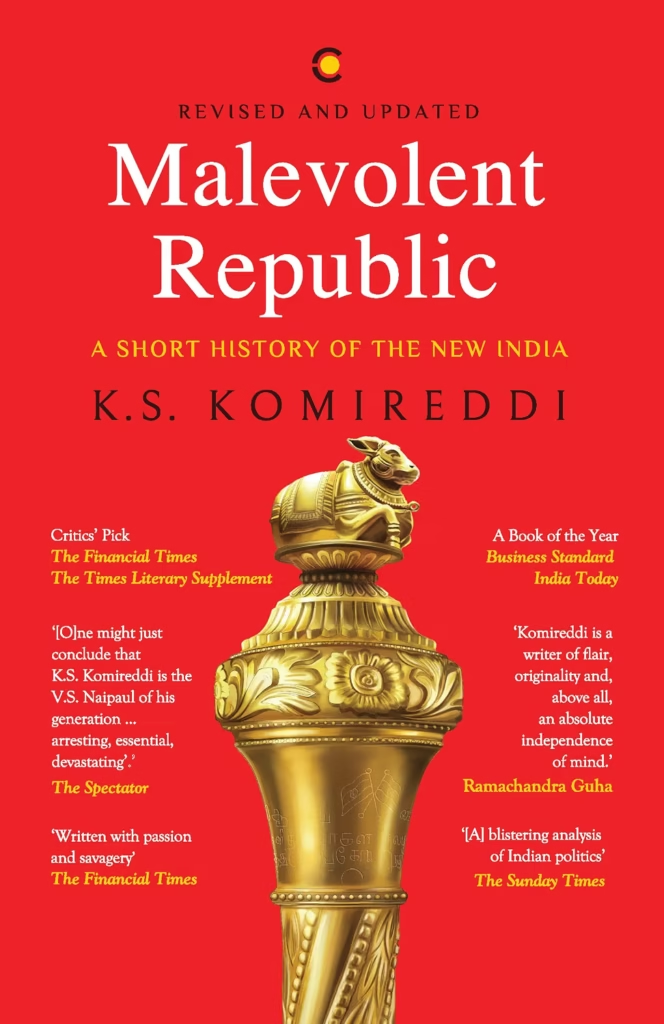
Malevolent Republic: A Short History of the New India by K. S. Komireddi is a sharp and often provocative critique of post-independence India and its political leadership. Moving from Jawaharlal Nehru and Indira Gandhi to economic liberalisation, the rise of Hindutva and Narendra Modi, Komireddi examines what he sees as the political, social and moral failures that have shaped modern India. Polemical rather than detached, the book offers a deeply critical account of the country’s journey from the ideals of independence to the political climate of contemporary India.
Book: Malevolent Republic: A Short History of the New India
Author: K. S. Komireddi
Genre: Political Non-fiction / Indian History
Focus: Post-independence India, political leadership, communalism, Hindutva and contemporary politics
Period covered: Independence to 2019
Best for: Readers interested in Indian politics, modern Indian history and political commentary
About Malevolent Republic
Malevolent Republic is a scathing critique of India’s political journey from independence to 2019. K. S. Komireddi is direct and forthright in his assessment of successive governments and political leaders, and his criticism is not confined to one party or ideology.
The book begins with a personal anecdote before moving through some of the defining personalities and events of post-independence India. Komireddi examines Nehru and what he considers the failures of his policies, Indira Gandhi and the Emergency, Sanjay Gandhi and the sterilisation programme, and the assassination of Indira Gandhi. He then turns to Rajiv Gandhi, whose tenure he discusses in the context of corruption, communal politics and decisions that, in the author’s view, contributed to the consolidation of Hindutva politics.
The narrative continues through P. V. Narasimha Rao and economic liberalisation and the years of Manmohan Singh before turning its attention to the rise of Narendra Modi. Komireddi traces Modi’s journey from an RSS pracharak to Chief Minister of Gujarat and eventually Prime Minister, while examining the Gujarat violence of 2002, the growth of Hindu nationalism and the political changes that culminated in the BJP’s victory in the 2014 Lok Sabha election.
There is considerable anguish and frustration in Komireddi’s writing about the direction in which he believes India is moving. At the heart of the book is his argument that the country has gradually drifted away from many of the political and social ideals envisioned at independence. He is particularly concerned with communalism, religious majoritarianism and what he sees as the weakening of India’s social and moral fabric for political gain.
This makes Malevolent Republic a dark and sometimes depressing read. It is also deliberately polemical. Readers may not agree with every conclusion Komireddi reaches, but the book does not really ask for passive agreement. Its strength lies in provoking questions about India’s political journey: what went wrong, who bears responsibility, and how did the country arrive at its present moment? Komireddi does not offer an easy solution; instead, he leaves the reader with plenty to pause over and introspect upon.
Who Should Read This Book
Malevolent Republic will appeal particularly to readers interested in Indian politics, post-independence history, secularism, communalism and the rise of Hindu nationalism. It is highly readable and relatively concise, making it suitable for readers who want an overview of modern India’s political journey without picking up a lengthy conventional history.
However, this is not a neutral or dispassionate history of independent India. Komireddi writes with a strong political perspective, and his anger and frustration are evident throughout the book. Readers who enjoy political commentary and are comfortable engaging with an author’s arguments—even when they disagree with them—are likely to get the most from it.
If you dislike politics or strongly opinionated social commentary, this may not be the book for you. But if you enjoy books that challenge your understanding of contemporary India and make you question how the country arrived at its present political moment, Malevolent Republic is worth reading.
About the author
KS (Kapil Satish) Komireddi was born in India, and educated there and in England. His commentary, criticism, and journalism – from South Asia, Eastern Europe, and the Middle East – have appeared, among other publications, in The Economist, The New York Times, The Washington Post, The Los Angeles Times, The Guardian, The New Statesman, The Spectator, TIME, Foreign Policy, and The Jewish Chronicle. This is his first book.
Related Reading

About the reviewer

Manoj Payal
Manoj is an avid reader and a writer in progress, with interests spanning literature, history, politics, and the social sciences. His writing across book reviews, essays, articles, and poetry—explores ideas, society, and the human experience.He has spent over two decades working in the IT industry, a background that informs his analytical approach to reading and writing.