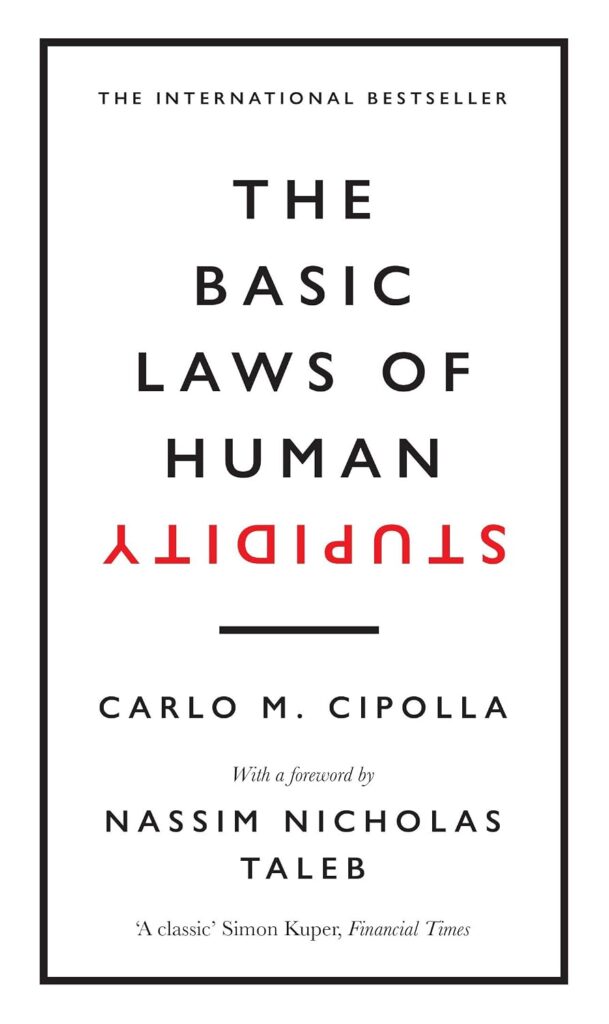
“Always and inevitably everyone underestimates the number of stupid individuals in circulation.”
Book: The Basic Laws of Human Stupidity
Author: Carlo M. Cipolla
Form: Short non-fiction / economic essay / humour
Subject: Human stupidity and its social consequences
Main themes: stupidity, irrational behaviour, human behaviour, social damage, decision-making, self-interest, public life, and the danger of unreasonable people
Best for: Readers interested in human behaviour, social commentary, economic thinking, political absurdity, humour, and short thought-provoking non-fiction.
Why I Picked - The Basic Laws of Human Stupidity
The Basic Laws of Human Stupidity — the title itself was an instant attention grabber. More so, because of the stupidity we see around us nowadays. I was curious to know what the laws say about stupidity and stupid people around us. I also wondered whether I would qualify as one according to the laws mentioned in the book 😊. Thankfully, not!
The book is not merely a satirical take on stupidity. Cipolla uses a simple economic model to analyse what stupidity is and who may be called stupid. To know more about what the author had to say about stupidity, I picked this one up.
About The Basic Laws of Human Stupidity
The Basic Laws of Human Stupidity talks about five laws that describe stupid people and their effect on society. The author gives a simple definition of who qualifies as stupid under the golden rule of stupidity. Although he defines it through an economic model, the idea can easily be extended to general stupidity as well.
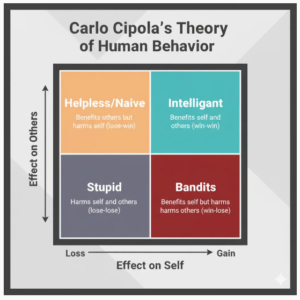
A stupid person is a person who causes losses to another person or to a group of persons while himself deriving no gain and even possibly incurring losses.
Does it ring a bell? Do you have such people around you? If yes, then they can safely be assumed to be stupid under Cipolla’s definition. The author provides a definition of what makes someone stupid; why they do what they do is perhaps a matter for another study. Based on this definition, the author lays down certain laws about stupid people and stupidity. And when you read them, you think, analyze, and often agree with him.
We have seen people around us giving boycott calls for a movie or a show just to cause loss to someone. We may assume that such people are minuscule in number or merely an aberration, but Cipolla’s laws challenge this assumption.
One needs to read the book diligently, and perhaps re-read it, to understand the metaphor and arrive at one’s own interpretation. The argument also makes one think about our present moment. For example, we often run after a model of development at the cost of the environment, convincing ourselves that it is good for everyone, only to realize later that the damage may be irreversible.
Of course, this is not limited to ordinary people. We see many examples around us: retired, and sometimes even serving, people with years of experience in fields such as the armed forces, education, science, economics, and law mouthing abusive language and warmongering almost every day on television channels, though it would be technically wrong to call some of them news channels. People expect maturity and intelligence from individuals who have held high and dignified positions, but what they often find is offensive language. In the process, the quality of public debate and discussion is lowered, damaging the collective intelligence of society.
The probability that a certain person be stupid is independent of any other characteristic of that person.
The book uses a simple economic model, and while reading it, you may find that the laws it mentions do offer a useful way of studying human behaviour. It does not tell us why stupid people do what they do, but it surely lets us know that there are a lot of them out there, and they are a danger to society. They are not driven by logic or rationality, so one cannot easily contemplate or foresee their actions and prepare for them.
After reading the book, you would certainly realize that human stupidity has no limit. As the book says, stupid people are always more numerous than we estimate them to be. I have seen people around me celebrating higher taxes, being okay with price rise, and even justifying it, though it impacts them and their budgets. All of them do qualify as stupid under Cipolla’s definition, and as the author rightly says, there are too many of them.
There is one more interesting aspect of human behaviour that the author brings forth. He places people in four different quadrants and, based on the cost-benefit analysis of any specific action, calls them helpless, bandits, intelligent, or stupid. This makes the book even more interesting because it turns a common word like “stupidity” into a framework for understanding behaviour. Publishers Weekly also notes Cipolla’s four categories: helpless, intelligent, bandit, and stupid.
An interesting and insightful read. In the author’s own words, the book is a constructive effort to detect, understand, and possibly neutralize one of the dark forces that hinders human welfare and happiness.
Who Should Read This Book
I would recommend this book to everyone. It is short, easy to read, and can be finished in one sitting. You may even come out feeling a little enlightened after reading it. It helps us identify the stupid people around us, and now we also have categories to define them. 🙂
It is also a good chance to check whether we ourselves are behaving like one.
Our Verdict
The Basic Laws of Human Stupidity is a short, sharp, witty, and thought-provoking book that everyone should read. Cipolla takes something we often use casually as an insult and turns it into a serious way of thinking about human behaviour and social damage.
The strength of the book lies in its simplicity. You may laugh while reading it, but you will also start recognising examples from public life, politics, television debates, offices, families, and society around you. It is amusing, but also slightly alarming, because it reminds us that stupidity is not harmless. In large numbers, and especially in positions of power, it can become dangerous.
About the author
Carlo M. Cipolla was an Italian economic historian, Fulbright Fellow, and professor at the University of California, Berkeley. He was elected as a Corresponding Fellow of the British Academy in 1989 and was awarded the International Balzan Prize for Economic History in 1995. He also held honorary degrees in Italy and Switzerland. His classic treatise The Basic Laws of Human Stupidity has sold more than half a million copies worldwide in over ten languages.
About the reviewer

Manoj Payal
Manoj is an avid reader and a writer in progress, with interests spanning literature, history, politics, and the social sciences. His writing across book reviews, essays, articles, and poetry—explores ideas, society, and the human experience.He has spent over two decades working in the IT industry, a background that informs his analytical approach to reading and writing.