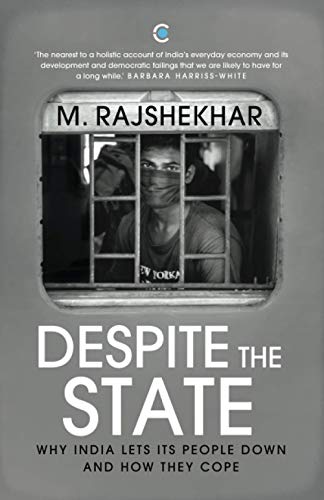
Despite the State: Why India Lets Its People Down and How They Cope by M. Rajshekhar is a powerful work of ground reporting on governance failure in India. The book examines how most Indians live despite the state, rather than flourishing under it, and how the structures responsible for this failure also threaten Indian democracy. Through reports from Mizoram, Odisha, Bihar, Gujarat Indian democracy. Through reports from, Punjab, and Tamil Nadu, Rajshekhar shows how state governments fail to provide basic services, protect natural resources, and uphold the rights of ordinary citizens.
Book: Despite the State: Why India Lets Its People Down and How They Cope
Author: M. Rajshekhar
Form: Reportage / political non-fiction / Indian non-fiction
Subject: Governance failure in India and how citizens cope when the state fails to provide basic rights and services
States covered: Mizoram, Odisha, Bihar, Gujarat, Punjab, and Tamil Nadu
Main themes: state failure, governance, democracy, health, education, justice, natural resources, corruption, regional politics, inequality, environment, political parties, and citizens’ struggles
Best for: Readers interested in Indian politics, governance, public policy, democracy, ground reporting, social development, inequality, and why India continues to struggle on basic human-development indicators.
Why I Picked - Despite the State
I found the title of the book interesting. And the question it posed — “Why India lets its people down and how they cope” — was something that had been bothering me as well. To find some answers, I picked up this book, and it was more than worth a read.
About - Despite the State
Despite the State is a fine example of ground reporting by journalist M. Rajshekhar. Working on a project called Ear to the Ground, the author covered six Indian states and tried to understand how state governments consistently failed their citizens.
On one hand, the state failed to provide basic amenities such as schools and healthcare. On the other, it plundered the natural resources of the country. From the northeastern state of Mizoram to Odisha, Bihar, Gujarat, Punjab, and Tamil Nadu, the author chronicles the failure of the state to provide the one thing it is elected to provide — governance.
All these states are plagued by different problems, but they have one thing in common: the abdication of responsibility by the state towards its people.
The hilly state of Mizoram is unable to pay salaries to its employees because it is not able to generate enough revenue, largely due to poor economic policies or the lack of them. Odisha, despite being a mineral-rich state, remains backward, with many of its people living in abject poverty because its natural resources have been plundered to favour a select few.
In Punjab, one family’s control over resources becomes a major concern. Tamil Nadu, once considered a welfare state, is now mired in populism despite some good work done by the government. Gujarat, touted as a “model” state by Prime Minister Modi and various media houses over the years, appears as a laboratory of majoritarian politics, which has now spread across the country. And Bihar, as the general perception goes, remains a state where governance is largely absent.
Rajshekhar writes that he found state failure in all six states he reported from. Governments failed to deliver health, education, and justice. Self-interested political parties, unable to deal with the challenges before their states, hid their failures through denial, diversion, leadership cults, and endorsements from others. Watchdog institutions rarely held power accountable. Citizens fell back not on democratic remedies, but on caste and religious structures to keep insecurity at bay. In all, Indian democracy seemed more performative than real.
The author tells stories of the state neglecting its primary responsibilities, colluding with industrialists to favour them in the looting of national resources, and showing apathy towards the problems faced by common people. As a result of unchecked irregularities, it is the citizens who face the consequences — environmental degradation, pollution, and loss of livelihood — with those at the bottom suffering the most.
The book also comments on the falling state of democracy in India and the suppression of citizens’ democratic rights. It shows a state that has abandoned its most vulnerable people while remaining hand in glove with the rich and powerful.
There is some excellent reportage in the book. Rajshekhar travels across these six states and speaks to people on the ground. As V. Geetha says in the afterword, “This is new writing. The focus is not ‘India’, either as an idea or material entity, but an India as lived by millions of its citizens: within bounded linguistic and cultural limits, shaped by political traditions that are specific to the region in question and which cannot be easily assimilated to broad theories of ‘development’.”
Despite the State is a very informative and insightful book, backed by strong on-the-ground reporting. It helps readers understand the working of government and the failures of governance. It is a must-read for anyone who wants to know what plagues our system and why, despite having so much, India still lacks in many social and human-development parameters.
Add Your Heading Text Here
M. Rajshekhar started his career as a business reporter in 1997. He joined Scroll.in in 2015 to work on a thirty-three-month-long reporting project, Ear to the Ground, which became the foundation for this book.
The series won the Ramnath Goenka Excellence in Journalism Award in 2015, the Bala Kailasam Memorial Award in 2016, and two Shriram Awards for Excellence in Financial Journalism in 2015 and 2016. Rajshekhar now writes on energy, environment, climate change, political corruption, and oligarchy. Hisreportage can be found at his website.
Related Reading
About the reviewer

Manoj Payal
Manoj is an avid reader and a writer in progress, with interests spanning literature, history, politics, and the social sciences. His writing across book reviews, essays, articles, and poetry—explores ideas, society, and the human experience.He has spent over two decades working in the IT industry, a background that informs his analytical approach to reading and writing.