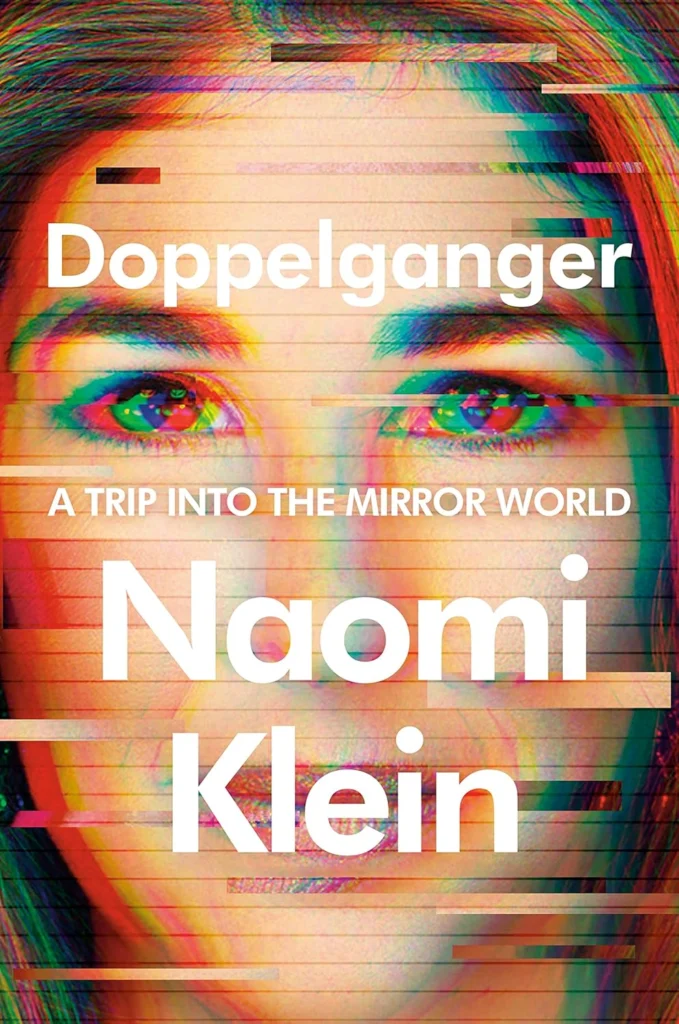
Doppelganger: A Trip Into the Mirror World by Naomi Klein is a thought-provoking book about identity, digital doubles, conspiracy thinking, political distortion, and the strange mirror world created by social media and modern politics. Through her confusion with Naomi Wolf, Klein explores how ideas, language, and ideologies are copied, twisted, and repackaged in ways that make the present world feel deeply unsettling.
Book: Doppelganger: A Trip Into the Mirror World
Author: Naomi Klein
Form: Non-fiction / political and cultural commentary
Subject: Digital identity, conspiracy politics, ideological distortion, and the mirror world
Main themes: doppelgangers, social media, conspiracy theories, political language, identity, ideology, digital selves, misinformation, and self-reflection
Best for: Readers interested in politics, media, social media, identity, conspiracy culture, and how language is distorted in the digital age
About Doppelganger
The dictionary defines a “doppelganger” as a look-alike or a double of a person. In Doppelganger: A Trip Into the Mirror World, Naomi Klein takes this idea beyond physical resemblance and leads us into a world of doubles that exist both in reality and in the digital sphere.
The book explores how our beliefs, language, and ideologies are taken over, mirrored, and distorted by these doubles in ways we often fail to anticipate.
Klein begins with a personal and unsettling realization: she is repeatedly mistaken for Naomi Wolf, whom she refers to as “the other Naomi,” because of Wolf’s frequent appearances and statements on television and social media. This confusion prompts Klein to follow Wolf more closely, and what she discovers becomes central to the book.
Once a prominent feminist voice firmly rooted on the left, Wolf has taken a dramatic turn, aligning herself with right-wing politics and conspiracy theories. In the digital world, Klein suggests, this ideological shift has also helped Wolf acquire a new audience and renewed relevance.
The book goes on to examine a deeply confusing political landscape where opposing ideologies begin to mirror each other, borrowing language, grievances, and symbols from across the spectrum.
This is something I see unfolding in India today. Right-wing Hindutva politics increasingly positions itself as a victim, even as it actively marginalises minorities — religious, social, and economic. The claim of persecution runs parallel to the persecution itself.
One prominent right-wing advocate has even authored a book titled Hindus in Hindu Rashtra: Eighth-Class Citizens and Victims of State-Sanctioned Apartheid. In the context of lynchings, everyday bullying, and the destruction of homes and livelihoods through state-sanctioned demolitions, such claims appear almost surreal.
Yet they exist, and they thrive — precisely in the mirror world that Klein seeks to understand.
In the age of social media, the constant race to stay informed, visible, and liked places immense pressure on individuals to brand themselves in a particular way. This curated identity may or may not reflect who they truly are.
As a result, our digital selves can begin to function as our doppelgangers. Depending on the platform, this double may represent the best version of us or the worst.
On Instagram, one might project a carefully crafted image of happiness or success. On Twitter, the same person may appear combative or cynical. And in real life, they may be neither — existing somewhere in between, unfiltered and unseen.
Writing Style
Naomi Klein writes with self-awareness, seriousness, and intellectual honesty. What makes the book compelling is that she does not exempt herself. She writes about her own discomfort, fear, and the danger of becoming trapped in reaction.
The book is dense and demanding, but it rewards slow reading. It resists easy binaries and refuses to pretend that only “the other side” is vulnerable to distortion.
It took me more time than I usually take to read a book of this length. It is a difficult book; you have to pause and think to make sense of it. Yet it is an essential read if we want to make better sense of the world around us.
Who Should Read Doppelganger
Doppelganger is for readers interested in politics, social media, conspiracy theories, identity, language, and the strange ways in which ideas are distorted in the digital world.
It is especially useful for those trying to make sense of the confusing political and cultural moment we are living through.
Our Verdict
This is not a book that offers easy solutions. It does not promise escape from the mirror world. What it offers instead is recognition — a naming of the unease many of us feel when familiar ideas start sounding unfamiliar in unfamiliar mouths, when language no longer guarantees intent, and when the line between critique and conspiracy begins to blur.
Doppelganger asks us to slow down and look closely, not just at those we disagree with, but also at ourselves. It asks uncomfortable questions about how we participate in this economy of mirrors, how easily we consume narratives that confirm what we already believe, and how quickly we dismiss complexity in favour of allegiance.
About the author
Naomi Klein is an award-winning, New York Times bestselling author of nine critically acclaimed books published in over 35 languages. Naomi Klein is a columnist with The Guardian. She has also written regular columns for The Intercept (as Senior Contributing Writer), The Nation, and The Globe and Mail that were syndicated in major newspapers around the world by The New York Times Syndicate.
Related Readings




About the reviewer

Manoj Payal
Manoj is an avid reader and a writer in progress, with interests spanning literature, history, politics, and the social sciences. His writing across book reviews, essays, articles, and poetry—explores ideas, society, and the human experience.He has spent over two decades working in the IT industry, a background that informs his analytical approach to reading and writing.