All of which brings us to the perennial North American question. Just what is it that Indians want? Sovereignty? Self-determination? A future? Good jobs? A late-model pickup truck? I get asked that question all the time. What do Indians want? The good news is that you could choose from any of the above and be right.
And you’d be wrong.
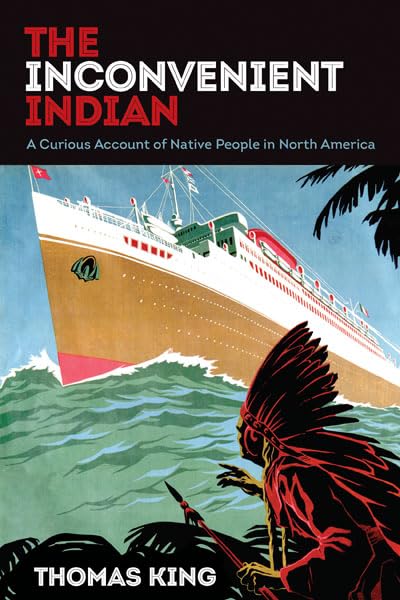
Book: The Inconvenient Indian: A Curious Account of Native People in North America
Author: Thomas King
Form: Non-fiction / history / social commentary
Subject: Indigenous peoples in North America and the history of colonialism, land dispossession, treaties, identity, and representation in Canada and the United States
Main themes: Indigenous history, colonialism, land, treaties, forced assimilation, reserves and reservations, First Nations, Native Americans, Indian Act, identity, popular culture, state power, capitalism, development, sovereignty
Best for: Readers interested in North American history, Indigenous peoples, colonialism, identity, land rights, Canada, the United States, and how history is written from the perspective of those who were displaced.
The Inconvenient Indian, by Thomas King is about the original inhabitants of North America which is now known as Canada and USA. There are three Aboriginal (Indigenous) groups in Canada – First Nations (Indians), Metis, Inuit. This book is primarily about Indians – called First Nations in Canada and Native American or American Indian in the US. It tells us the story/history of North America from the perspective of the Indigenous people of the land.
The story of colonialism and capitalism is same everywhere around the world – the relentless pursuit of land, power, and profit accompanied by the forced assimilation and transformation of the Indigenous peoples against their will. In the old days it was the countries and the trading companies that used to colonize far way lands and subjugated their people. In the present day the role is played by corporations with the help of governments. What remains constant, however, is the displacement of Indigenous people from their ancestral lands in the name of natural resources and “development”, leaving them marginalized in their own home.
Thomas King offers a brief history of how Europeans arrived in North America and how the original inhabitant of this continent came to be labelled as “Indians” – because the explorers thought that they have reached India. From this point begins a compelling journey that takes the readers through the story of Indigenous people of North America, through their own perspective. We learn how the British and French expanded their ‘empire’ through brutal force, deceptive treaties and strategic use of religion. The treaties, in effect, were instruments to seize land, while religion was employed as a tool to “civilize” Indigenous peoples and force their assimilation to avoid wars, wherever possible.
While I was broadly aware of the history of North America, I lacked a detailed understanding of the experiences of its Indigenous peoples. This book serves as an eye-opening overview of their lives, their systematic marginalization, and the ways in which successive governments have treated them. It also sheds light on the enduring perceptions and prejudices held by white society, many of which continue to shape public attitudes even today. The author pointed out how movies, arts and popular culture have also shaped up the perception and created an image of the Indigenous people among the general population of North America.
We often bracket Indigenous peoples into a single, homogeneous group, when in reality their identities are far more complex and nuanced. As mentioned earlier, in Canada alone Indigenous peoples are broadly categorized as First Nations, Métis, and Inuit, but even within these groups there exist further layers of differentiation—legal, cultural, and linguistic. These distinctions are not merely academic; they shape lived realities, rights, and access to resources.
What is particularly baffling is the extent to which these identities have been defined and regulated by the state. Under the Indian Act, for instance, First Nations peoples are officially classified as “Status Indians” and “Non-Status Indians” based on whether they are registered with the government. This bureaucratic categorization determines who is legally recognized as Indian and who is not, reducing complex identities and histories to administrative labels. Such classifications reveal how colonial power extended beyond land and governance, reaching into the very definition of identity itself.
In this system, the “inconvenient Indian” is the one who refuses to let the state decide their identity.
The book is a portal that takes readers into the making of Canada and the United States, revealing the heavy price paid by Indigenous peoples. It exposes the historical injustices endured by the original inhabitants of the continent—how they were systematically confined to reserves, had their lands seized by governments and corporations, and how many continue to fight for their land, rights, and identity to this day. It is a sad reality that behind all North America’s development and progress lies the oppression and suffering of its Indigenous peoples.
What makes The Inconvenient Indian particularly compelling is Thomas King’s voice. Drawing on deep knowledge, careful research, and a sharp sense of humour, he tells a story that could easily have been relentlessly grim. Instead, his wit and irony soften the weight of history without diluting its seriousness, allowing the reader to confront uncomfortable truths without being overwhelmed. It is this balance—between anger and humour, pain and perspective—that makes the book both accessible and deeply unsettling.
An insightful, engaging, and informative book that reveals the history of Canada and the USA through the eyes of Indigenous peoples. A must-read for anyone with a curiosity and interest in history.
Who should read
The Inconvenient Indian is for readers who want to understand the history of Canada and the United States from the perspective of Indigenous peoples. It is especially useful for those interested in colonialism, land, treaties, forced assimilation, identity, and the long history of how Indigenous communities were displaced and marginalised in their own lands.
Readers who are curious about how governments define identity, how popular culture shapes public perception, and how land remains central to Indigenous struggles will also find the book meaningful. Thomas King writes about painful history with wit, irony, and sharp observation, which makes the book accessible without reducing the seriousness of its subject.
This is a good read for anyone interested in history beyond the official version — especially those who want to understand the relationship between power, land, identity, and memory in North America.
About the author
Thomas King is American-Canadian writer whose work often explores Indigenous history, identity, and North American colonialism. He was the first Aboriginal person (though King has publicly accepted genealogical findings that he has no Indigenous ancestry) to deliver the prestigious Massey Lectures, and he is the best-selling, award-winning author of six novels, two collections of short stories, and two nonfiction books. The Inconvenient Indian won the BC National Award for Canadian Non-Fiction and the RBC Taylor Prize. He is a recipient of the Order of Canada and lives in Guelph, Ontario.
Similar Books


About the reviewer

Manoj Payal
Manoj is an avid reader and a writer in progress, with interests spanning literature, history, politics, and the social sciences. His writing across book reviews, essays, articles, and poetry—explores ideas, society, and the human experience.He has spent over two decades working in the IT industry, a background that informs his analytical approach to reading and writing.