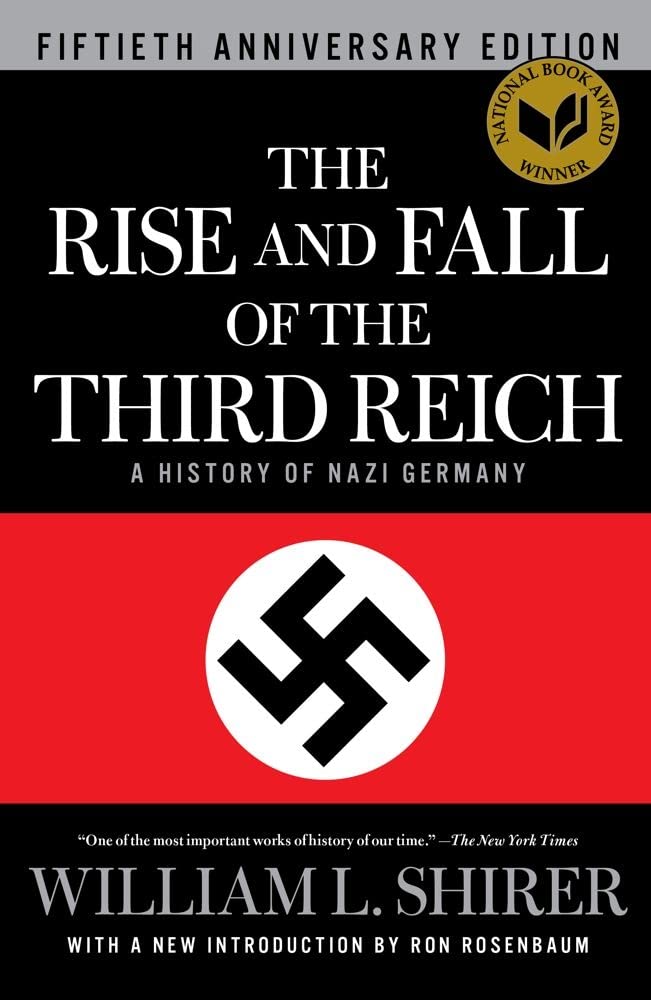
The Rise and Fall of the Third Reich by William L. Shirer is a detailed historical account of Adolf Hitler, Nazi Germany, World War II, and the destruction caused by fascism, propaganda, antisemitism, and absolute power. The book traces Hitler’s journey from his early years in Austria to his rise as the dictator of Germany, the Nazification of society, the persecution of Jews, the ideology of Lebensraum, and the war that devastated Europe. This review looks at how Shirer documents the making of Hitler, the rise of the Nazi state, and the fall of the Third Reich.
Book: The Rise and Fall of the Third Reich
Author: William L. Shirer
Form: History / political non-fiction
Subject: Hitler, Nazi Germany, World War II, and the fall of the Third Reich
Main themes: Adolf Hitler, Nazi Germany, antisemitism, propaganda, dictatorship, nationalism, World War II, Lebensraum, genocide, and the destruction of Europe
Best for: Readers interested in history, World War II, Nazi Germany, dictatorships, political extremism, and detailed historical documentation
Why I Picked The Rise and Fall of the Third Reich
I picked up The Rise and Fall of the Third Reich because I wanted to read in detail about the making of Hitler, Nazi Germany, and World War II.
The book promised to explain how a small-town boy from Austria, who failed as an artist and lived in poverty in Vienna, went on to become the symbol of right-wing nationalism in Germany and eventually the dictator with absolute power over the German people.
For anyone interested in history, especially the period between the 1930s and 1945, this book offers one of the most detailed accounts of how Hitler became Hitler and where his fanaticism led Germany and the world.
About - The Rise and Fall of the Third Reich
The Rise and Fall of the Third Reich is a detailed historical documentation of the making of Hitler and his cronies.
It takes readers through Hitler’s journey from Austria to Vienna, from his early political obsession to his rise as the leader of Nazi Germany. The author captures all of this in great detail — his contempt and hatred for Jews, his fanatical German nationalism, his madness for making Germany the greatest power on earth, and the destruction that followed.
In the process, Hitler threw Germany and the whole of Europe into a world war, which ended in devastation, destruction, and the death of millions.
The Making of Hitler
The author takes readers into the journey of how Hitler became Hitler.
Shirer writes about Hitler’s early years, his days of penury in Vienna, his hatred for the Hapsburg monarchy, his dislike for non-German races in the Austro-Hungarian Empire, and his violent love for everything German.
There are details of how Hitler first tried to capture power through force during the Beer Hall Putsch in November 1923, and how, after its failure, he used the democratic process to come to power.
Once he came to power, he crushed democracy itself.
Democracy, Propaganda, and the Rise of Nazi Germany
The book explains the initial days of Hitler’s political career, his becoming Chancellor of Germany, and how he created nationalist feelings among Germans.
A feeling was created among the people that Germany had been wronged and only Hitler could help bring back the glory and respect of the nation. The complete loyalty of many Germans towards Hitler made him the undisputed leader of Germany.
This was helped and fueled by propaganda minister Joseph Goebbels, who carefully created a myth around Hitler and turned him into a god-like figure in Germany.
Antisemitism, Nazification, and Life Under Hitler
Shirer dwells in detail on life in Nazi Germany from 1933 onwards.
The book captures the complete Nazification of Germany, beginning with state control over education and media. It also explains how Jews were systematically othered, humiliated, excluded, and persecuted.
The author details the atrocities committed against Jews and the genocide of epic proportions that followed. Many Jews were killed, while many others fled Germany.
This section of the book is disturbing because it shows how hatred can slowly be normalized through politics, propaganda, and state power.
Lebensraum, War, and the Destruction of Europe
Hitler’s greed and madness are captured in detail through diaries and documents seized at the end of the war.
The book explains his ideology of Lebensraum, meaning living space for German people in the east. It gives details about his initial aggression and the capture of Austria, Czechoslovakia, and Poland, along with his treaties with Russia, Italy, and Japan.
Then came the final declaration of war by Britain against Germany.
The six years of war, starting in 1939 and ending in 1945, are captured in great detail. Every battle during this period is described in such a way that the reader can almost imagine it happening in front of them.
Ultimately, the reader gets to know how the madness of one man led the whole of Europe and the world into war, causing destruction of epic proportions and leaving millions dead.
Writing Style
The book is written very well, and despite being lengthy, it remains informative and interesting.
What makes the book powerful is that William L. Shirer writes not only as a historian, but also as a journalist who witnessed many of the events closely. His experience as a foreign correspondent in Germany gives the book a sense of immediacy. At many places, the reader feels that the events are being reported by someone who has seen the atmosphere, the people, and the rise of Nazi power from close quarters.
History buffs will enjoy reading it. However, because it contains so much detail, at times one might feel overwhelmed with information, especially with so many names, events, battles, and political developments.
The chapters are arranged very well, and the reader gets to understand events chronologically. This makes the book easier to follow despite its length and depth.
Who Should Read - The Rise and Fall of the Third Reich
The Rise and Fall of the Third Reich is useful for readers who are interested in history, World War II, Nazi Germany, Adolf Hitler, fascism, propaganda, and the rise of dictatorship.
Anyone who wants to read in detail about the making of Hitler and the Second World War will find this book important.
It is not a light read, because the amount of information is vast. But for serious readers of history, this is one of those books that gives a detailed understanding of how politics, hatred, nationalism, propaganda, and absolute power can destroy a country and the world around it.
Our Verdict
The Rise and Fall of the Third Reich is a must-read for everyone interested in history.
Anyone who wants to read in detail about the making of Hitler, Nazi Germany, and World War II should pick this book. It is detailed, informative, and deeply important because it shows how one man’s fanaticism, combined with propaganda, hatred, and blind loyalty, led Germany and the world towards destruction.
About the Author
William L. Shirer ranks as one of the greatest American foreign correspondents. He lived and worked in Paris, Berlin, Vienna, and Rome.
His reputation was established above all as a correspondent in Germany for the Chicago Tribune and later for the Columbia Broadcasting System in the late 1930s. He later wrote The Rise and Fall of the Third Reich, which is widely regarded as a classic.
After World War II, he was awarded the Legion d’Honneur. In the post-war years, he wrote in a variety of fields, and in his seventies he learned Russian, publishing a biography of Tolstoy at the age of 89. He died in 1994. His Berlin broadcasts were published posthumously in 1999.
Related Reading
If The Rise and Fall of the Third Reich interests you, these related reviews may help you explore history, politics, violence, ideology, and the dangers of authoritarian power further.

About the reviewer

Manoj Payal
Manoj is an avid reader and a writer in progress, with interests spanning literature, history, politics, and the social sciences. His writing across book reviews, essays, articles, and poetry—explores ideas, society, and the human experience.He has spent over two decades working in the IT industry, a background that informs his analytical approach to reading and writing.