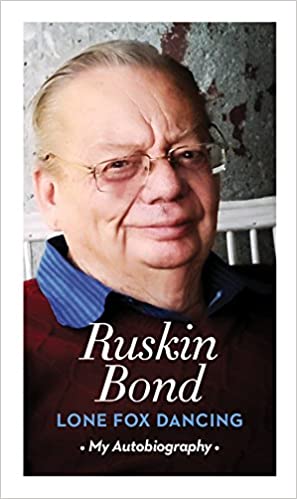
Lone Fox Dancing: My Autobiography by Ruskin Bond is an intimate and nostalgic account of the life of one of India’s most loved writers. From his childhood in Jamnagar and boarding-school years in Shimla to his time in Delhi and England and his eventual home in Mussoorie, Bond looks back at the people, places and experiences that shaped both his life and his writing. Told with his characteristic simplicity, warmth and humour, the autobiography offers a glimpse not only into the making of a writer but also into an India that has changed considerably over the course of his lifetime.
Book: Lone Fox Dancing: My Autobiography
Author: Ruskin Bond
Genre: Autobiography / Memoir
First published: 2017
Publisher: Speaking Tiger
Focus: Childhood, family, loneliness, writing, friendship, India and Mussoorie
Best for: Readers of Ruskin Bond, memoirs, Indian literature and nostalgic writing
Why I Picked Lone Fox Dancing
I love reading Ruskin Bond. His stories are simple yet beautifully written, and the way he describes places and characters has always appealed to me. His writing can transport you to another place and another time; you can relate to his characters, and sometimes they even remind you of people you know. Most of all, his writing takes me to the hills of Uttarakhand, and I love being there. Having read and enjoyed his work, I wanted to know more about the man behind those stories and the experiences that shaped him as a writer. Lone Fox Dancing therefore felt like a natural book for me to pick up.
About Lone Fox Dancing
Lone Fox Dancing is an autobiography written with remarkable honesty and intimacy. Ruskin Bond takes us through his life from his childhood to his later years as an established writer. The journey moves from Jamnagar to Delhi, Shimla and England before eventually bringing him to the hills and Mussoorie. The book is filled with anecdotes, memories and observations, narrated with the wit and simplicity that make Bond’s writing so enjoyable.
He recalls his boarding-school days in Shimla, the different places he lived, his friendships, his lonely childhood and the many people who passed through his life. One of the things I particularly enjoyed is the way he remembers places. The cities and towns are not merely backgrounds to his story; they become part of it. When Bond describes Delhi of the 1940s, for instance, you can almost visualize the city as it might have looked at the time.
Yesterday I dreamed again that I was lost in a large city of blinding lights and traffic. I was feeling quite helpless until a small boy took my hand and led me to the safety of these mountains I knew so well. I wanted him to stay – I was certain I knew him – but he turned and walked away, whistling, hands in the pockets of his khaki shorts, and as I called out to ask his name, I woke up.
The book also gives us glimpses into the making of some of his well-known works and his journey towards becoming an established writer. Yet there is very little self-importance in the way he tells his story. Even after a long and successful literary career, Bond writes about himself with an endearing humility.
And then there is Mussoorie. The affection with which Bond writes about the place that became his home is unmistakable. By the later part of the autobiography, we see him settled there with his adopted family, surrounded by the landscape and people that have appeared so often in his writing.
While reading Lone Fox Dancing, you sometimes feel as though you are watching the author’s entire life unfold in front of you. It makes you sad, makes you smile, makes you wonder and, above all, makes you nostalgic. There are so many emotions that you experience while moving through the different stages of his life.
No life is more, or less, important, or interesting than another – much of it, after all, is lived inside our heads. I have finally yielded to friends who have been persuading me to the story of my life, but I am still not convinced it will be of any great value. I can only hope that it is, at least, a curiosity; a record of time gone by, an introduction to some interesting and unsung people, and a glimpse into one kind of writerly life.
Who Should Read Lone Fox Dancing
Lone Fox Dancing is a must-read for anyone who already loves Ruskin Bond, but I would recommend it equally to someone who has never read him before. Readers who enjoy autobiographies, stories of writers and books filled with memories of people and places will find much to enjoy here. Bond’s writing is simple, warm, witty and deeply nostalgic; there is no attempt to make an ordinary life appear extraordinary. Instead, it is the honesty and intimacy with which he remembers his childhood, friendships, loneliness, writing and the places he has called home that make the autobiography so engaging. If you are new to Ruskin Bond, this book might just begin a lifelong love affair with the writer.
About the author
Ruskin Bond is the author of several bestselling novels and collections of short stories, essays and poems. These include The Room on the Roof (winner of the John Llewellyn Rhys Prize), A Flight of Pigeons, The Night Train at Deoli, Time Stops at Shamli, Our Trees Still Grow in Dehra (winner of the Sahitya Akademi Award), Angry River, The Blue Umbrella, Rain in the Mountains, Roads to Mussoorie, A Little Night Music, Tigers for Dinner, Tales of Fosterganj, and A Gathering of Friends.
Ruskin Bond was awarded the Padma Shri by the Government of India in 1999, a Lifetime Achievement Award by the Delhi government in 2012 and the Padma Bhushan in 2014.
Related Readings

About the reviewer

Manoj Payal
Manoj is an avid reader and a writer in progress, with interests spanning literature, history, politics, and the social sciences. His writing across book reviews, essays, articles, and poetry—explores ideas, society, and the human experience.He has spent over two decades working in the IT industry, a background that informs his analytical approach to reading and writing.