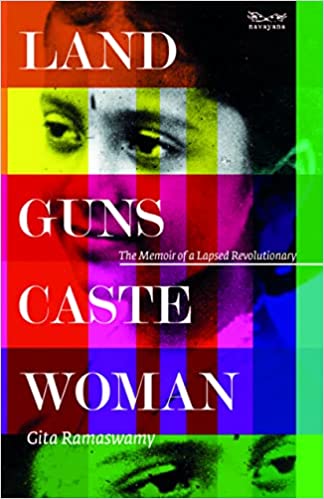
Land, Guns, Caste, Woman: The Memoir of a Lapsed Revolutionary by Gita Ramaswamy is an honest and powerful memoir about activism, caste, bonded labour, land struggles, and rural Telangana. The book traces Ramaswamy’s journey from her family background and college activism to her disillusionment with left politics, her work with Hyderabad Book Trust, and her decade-long struggle with landless Dalits and bonded labourers in Ibrahimpatnam. This review looks at how the memoir becomes not only the story of one woman’s life, but also a deep account of caste, land, power, and action on the ground.
Book: Land, Guns, Caste, Woman: The Memoir of a Lapsed Revolutionary
Author: Gita Ramaswamy
Form: Memoir / political non-fiction / Indian non-fiction
Subject: Gita Ramaswamy’s life, activism, and work with landless Dalits and bonded labourers in Telangana
Main themes: caste, land struggles, bonded labour, Dalit rights, rural Telangana, activism, left politics, Hyderabad Book Trust, landlords, social justice, and women in political movements
Best for: Readers interested in memoirs, Indian politics, caste, rural India, land rights, bonded labour, Dalit struggles, activism, and socially engaged non-fiction.
Why I Picked - Land, Guns, Caste, Woman
The title Land, Guns, Caste, Woman: The Memoir of a Lapsed Revolutionary drew my attention. I searched for Gita Ramaswamy and found her to be an intriguing personality.
She is a woman, a rights activist working with the poor, someone who was briefly part of a left organization during college, a co-founder of Hyderabad Book Trust, and later an activist who worked in the remote villages of Telangana, then part of Andhra Pradesh, with poor, landless, and bonded labourers.
About - Land, Guns, Caste, Woman
The book is a memoir of Gita Ramaswamy. The author takes readers through her family background and childhood to give us a perspective of where her family belonged in the social hierarchy.
The book then takes readers through the journey of Gita Ramaswamy’s life — her college days, her activism during those years, her inclination towards the Communist Party, and subsequently her disillusionment with its politics.
It also looks at her foray into publishing, where she co-founded Hyderabad Book Trust and published many books. She was doing fine, but somehow she was not satisfied with what she was doing. And then Ibrahimpatnam happened, where she worked with the poor, landless, and bonded labourers to help them get their land.
While reading the book, readers get to know many aspects of Gita’s life, the challenges she faced, and how she overcame them. Along with that, the book is also a study of rural Telangana society, its social and economic structure, and the composition of various villages.
It shows the condition of bonded labourers, Dalits, and poor villagers, along with the cheating and atrocities of rich and powerful landlords working in cahoots with the police and local administration.
It was indeed an achievement on Gita’s part to unite people against powerful landlords and a system that was against them. It was tough to organise people and instil confidence in them to fight for their rights, but Gita did it successfully, and the people of the area benefited from it.
For readers, it might or might not seem significant. But for the individual who got a piece of land registered in his name, or who was officially released from bonded labour, or whose daily wage increased as per the law, it meant everything.
In one powerful passage, Ramaswamy records how their efforts led to the release and rehabilitation of more than fifteen hundred bonded labourers, the unofficial release of many more, the repudiation of debt, and a rise in agricultural wages for women, men, and farmhands.
The book is an open and honest account of the author’s life and work. As I said earlier, it is not only a memoir of Gita Ramaswamy but also a deep dive into rural Telangana society. It looks at the composition of various castes, their placement and treatment in society, the hardships of people at the lower rungs, and how they deal with them.
For me, the key takeaway from the book is this: action is always greater than ideas. If something is wrong and you are uncomfortable with it, then you need to get on the ground and try to fix it. No amount of wishful thinking will change anything unless you do something about it.
Who Should Read Land, Guns, Caste, Woman
Land, Guns, Caste, Woman is for readers interested in memoirs, activism, caste, land struggles, bonded labour, and rural India. It is especially useful for those who want to understand how social change actually happens on the ground, beyond speeches, ideology, and theory.
Readers interested in Dalit struggles, Telangana’s rural society, left politics, and women activists will also find this book important. It is not just a personal memoir; it is also a record of courage, organizing, and the difficult work of standing with the poor and landless.
Our Verdict
Land, Guns, Caste, Woman: The Memoir of a Lapsed Revolutionary is Gita Ramaswamy’s honest and powerful account of her journey. It is a compelling choice for non-fiction readers, especially those interested in caste, activism, land rights, bonded labour, and rural India.
What makes the book important is that it does not remain only at the level of ideas. It shows what happens when someone actually goes to the ground, works with people, organises them, and helps them fight for dignity and justice. Readers less inclined toward non-fiction may find it challenging, but for those interested in socially engaged writing, this is a deeply valuable read.
About the author
Gita Ramaswamy is best known for her work with Hyderabad Book Trust, which has published over four hundred titles since 1980. She was earlier associated with the Marxist–Leninist movement in Telangana and, starting in 1984, worked for a decade with Dalits in Ibrahimpatnam in their fight against bonded labour and landlessness. She has authored several books and translated extensively from Telugu into English.
Related Reading

About the reviewer
Manoj Payal
Manoj is an avid reader and a writer in progress, with interests spanning literature, history, politics, and the social sciences. His writing across book reviews, essays, articles, and poetry—explores ideas, society, and the human experience.He has spent over two decades working in the IT industry, a background that informs his analytical approach to reading and writing.