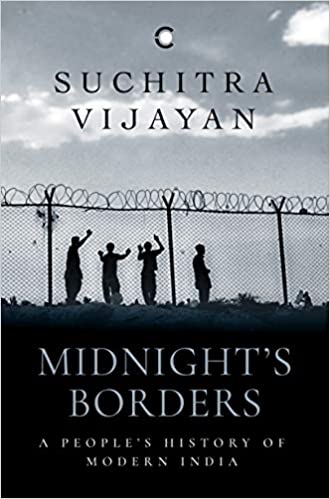
Midnight’s Borders by Suchitra Vijayan is a powerful work of reportage, history, travel, and political reflection on India’s borderlands. Through journeys across regions such as the India-Bangladesh, India-Myanmar, India-China, and India-Pakistan borders, the book shows how borders are not only lines on a map, but lived realities for the people who inhabit them. This review looks at how the book challenges mainstream narratives about nation, citizenship, violence, identity, and belonging.
Book: Midnight’s Borders: A People’s History of Modern India
Author: Suchitra Vijayan
Form: Reportage / travel writing / political non-fiction
Subject: India’s borderlands and the lives of people living near them
Main themes: borders, citizenship, state power, nationalism, Kashmir, Northeast India, migration, violence, memory, and belonging
Best for: Readers interested in Indian politics, borders, Kashmir, Northeast India, citizenship, history, reportage, and books by Indian women writers in English
Why I Picked Midnight’s Borders
I liked the title of the book and was intrigued by it. The book cover describes it as a people’s history of modern India, which kindled more interest because I enjoy reading history. It felt like a chance to understand India from the perspective of people living in the border areas of the country — their daily lives, their memories, and the day-to-day challenges faced by them. So, to know more about it, I picked up Midnight’s Borders.
About Midnight’s Borders
Midnight’s Borders captures the stories of common people living in and around India’s border areas. Suchitra Vijayan travels extensively through Indian border regions to tell us a brief history of these areas, the people who live there, and how borders have impacted their lives.
The book looks at how these borders came into being after Independence, what has changed over the years, and how those changes continue to affect ordinary people. For me, the book is important because it shows that borders are not only political or geographical lines; they also carry emotional, social, and human consequences.
Borders as Lived Realities
The book starts with a beautiful prologue and a fine introduction, which set the tone for the rest of the work. The author takes readers on a journey to the India-Bangladesh, India-Myanmar, India-China, and India-Pakistan border areas. She meets and interviews people living in these regions and, in the process, gives readers a history of each place.
Each story is moving and heartbreaking. As you read, you begin to think about the futility of borders and the suffering they create for people who simply happen to live near them.
The story of Ali from Jalpaiguri, who lives right at the edge of the India-Bangladesh border, is particularly disturbing. His village is completely sealed off and floodlit by lights on the borderline. The tragic story of what the border has done to his home and his life is unsettling.
Kashmir, the Northeast, and Mainstream Narratives
The stories from villages near the India-China border are also eye-opening. They challenge the general perception many of us have about the region, or what we usually hear about it. The reality on the ground is altogether different.
As you move through the book, you come across many stories of people living on the borders, and you are surprised to see how different things are from the mainstream narrative. The book not only tells us about the challenges and hardships faced by people living in border areas, but also gives citizens of the country a new perspective.
Nagaland, which borders Myanmar, is one such example. Through these stories, the reader is introduced to people who think about identity, dignity, history, and belonging in ways that many mainstream Indians rarely pause to understand.
The author then moves to the India-Pakistan border, and the most contentious part of that discussion is Kashmir. Here again, we get to hear and read something very different from the official Indian narrative. The book brings attention to how the history of Kashmir is often shaped, controlled, and told from the perspective of the state, while Kashmiri voices are pushed aside.
Readers who want to explore these questions further may also find my broader list of books on Kashmir useful, as it brings together different perspectives on the region’s history, politics, conflict, and lived experiences.
People, Memory, and State Power
Midnight’s Borders introduces readers to an India that is not part of the collective consciousness of most Indians. It is an India that is forgotten, not cared for, and left on its own by the people responsible for taking care of it.
The authorities are often concerned with the piece of land that falls within India according to the lines drawn on a map, while forgetting the people who actually live there. This is what makes the book powerful. It forces the reader to look beyond the map and think about the human cost of borders.
The people in the book are not just living near borders; they are living with the consequences of decisions made far away from them. Their stories reveal abandonment, fear, oppression, and uncertainty, but also memory, dignity, and the desire to be heard.
Writing Style
The book is told beautifully and with a lot of compassion. Suchitra Vijayan combines the stories of ordinary people with accounts of historical events that are often forgotten or ignored. The writing works because it does not treat border regions only as political subjects; it brings forward the lives of people who live there.
At the same time, the book is not always easy to read emotionally. Many of the stories are heartbreaking and make you uncomfortable. But that discomfort is important because it forces the reader to question the narratives we usually accept about borders, nation, identity, and belonging.
Who Should Read Midnight’s Borders
This book is useful for anyone interested in the history and politics of India. It is especially meaningful for readers who want to understand India beyond the mainstream narrative and beyond the neat lines shown on maps.
Readers interested in Kashmir, the Northeast, border politics, state power, forgotten histories, and the lives of ordinary people living in difficult political conditions will find this book important. It is also a good read for those who want to understand how borders affect not only land, but also people, memory, identity, and dignity.
Our Verdict
Midnight’s Borders is an insightful and informative read that takes readers through the lives of ordinary people living in the border areas of India. It tells stories of forgotten people and the challenges, oppression, and inhumanity they face at the hands of their own state.
This is a must-read for anyone interested in the history and politics of India. What makes the book important is that it shifts attention from the land to the people who live on that land. It reminds us that borders may be drawn on maps, but their consequences are lived by real people every day.
About the Author
Suchitra Vijayan was born and raised in Madras, India. Her work has appeared in The Washington Post, GQ, The Boston Review, The Hindu, and Foreign Policy. A barrister by training, she previously worked for the United Nations war crimes tribunals in Yugoslavia and Rwanda before co-founding the Resettlement Legal Aid Project in Cairo, which gives legal aid to Iraqi refugees.
She is an award-winning photographer, the founder and executive director of the Polis Project, a hybrid research and journalism organisation. She lives in New York.
Related Readings
If Midnight’s Borders interests you, these related reviews may help you explore Kashmir, borders, state power, citizenship, and lives outside mainstream narratives further. Rumours of Spring offers a personal account of growing up in Kashmir, while The Many Faces of Kashmiri Nationalism helps explain Kashmir’s political history and contested identities. You may also find my broader list of books on Kashmir useful for understanding the region through different voices and perspectives.
About the reviewer
Manoj Payal
Manoj is an avid reader and a writer in progress, with interests spanning literature, history, politics, and the social sciences. His writing across book reviews, essays, articles, and poetry—explores ideas, society, and the human experience.He has spent over two decades working in the IT industry, a background that informs his analytical approach to reading and writing.