The method of science and justice have much in common. Both attempt to shine a clarifying light on obscurity and uncertainty. At best, their core aim match, too, as they try to go beyond assumption and arrive at the truth through demonstrable facts. Yet because forensic science is made up of so many human layers – criminals, eyewitnesses, police officers, CSIs, scientists, lawyers, judges, juries – it cannot avoid either missing or misrepresenting the truth at times.
-Val McDermid
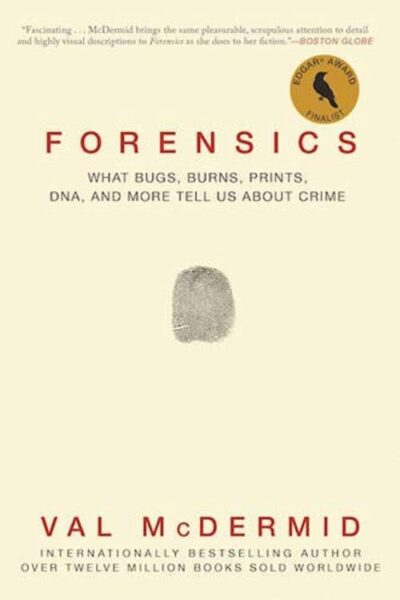
I came across “Forensics – What Bugs, Burns, Prints, DNA, and More Tell us About Crime”, while browsing books in the library to find my next read. The title immediately caught my attention. I knew about forensics but mostly through movies and television crime series but never read about it beyond that. Curious to understand what forensics consists of and how it helps solve crimes and reconstruct the stories behind them – I decided to pick up the book
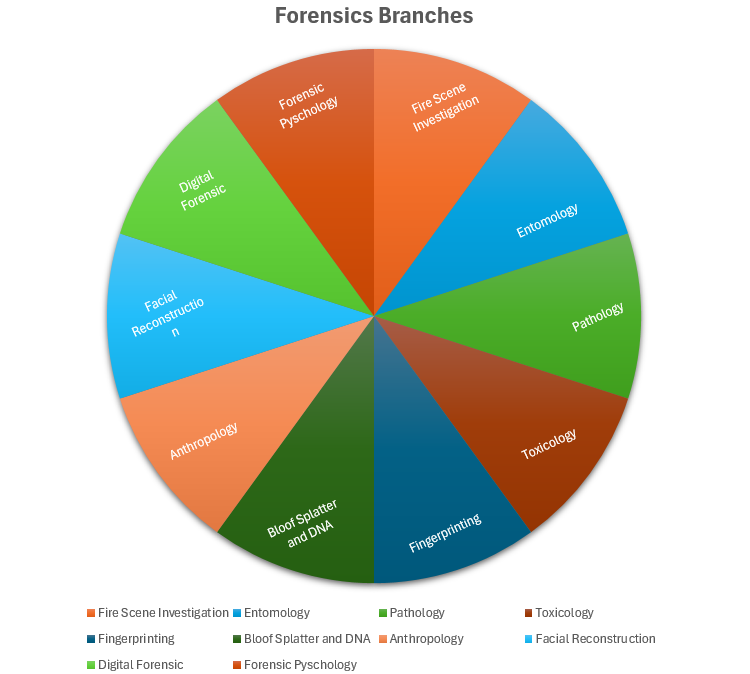
The book takes the readers into the world of crime scenes and reveals how various forensic scientists contribute at various stages of an investigation. It explains who arrives first at the crime scene, who collects the evidence, how it is gathered, and how it is preserved. We learn about the different branches of forensic science – yes there are specialist dedicated to specific tasks. Each expert works on a different piece of puzzle, but the goal is same, to reconstruct the crime and bring the perpetrators to justice.
Below is a graphical representation of the different branches of forensic science captured in the book.
I am sure many of us have heard about “Entomology” and even studied in zoology. Now imagine a branch of forensic science dedicated to study of insects – flies, maggots and more to uncover the details of a crime. Take the blowfly for instance, it has a strong sense of smell, and it will follow the smell until it reaches it source, making it nearly impossible to dispose and conceal a corpse from this persistent fly.
We all know that every individual has unique fingerprints, but did you know that we all also have unique forearm veins? Even more interesting part is that there are documented cases in which criminals have been identified/apprehended based on photographs of their veins. Such is the astonishing world of forensic science.
The author takes us through the various branches of forensic science – tracing their history, charting their evolution, and demonstrating how they have helped solve criminal cases and bring perpetrators to justice. As we move through each chapter, we are marvelled at the power of science and its ability to decode astonishing details about both the victim and the criminal – sometimes from nothing more than a single bone. With remarkable advancements, forensic science has progressed to DNA matching, digital forensics, and forensic psychology, all in pursuit of understanding the criminal mind, collecting evidence, and uncovering truths to deliver justice to the victims and their family.
The book also offers an important caution: despite the remarkable advances in forensic science, no single branch—or single piece of evidence—should be treated as conclusive on its own. Each discipline forms only one part of a much larger investigative puzzle. A fingerprint at a crime scene, for instance, does not automatically prove guilt; it must be examined alongside motive, opportunity, timeline, and other corroborating evidence. Forensic findings must be rigorously tested, questioned, and challenged by scientists themselves before being presented in court. The true aim of science, as the book reminds us, is not to chase one convenient conclusion, but to consider every possibility before arriving at the truth.
A very well-written book that is both accessible and engaging. The chapters are thoughtfully organised, making complex scientific concepts easy to follow and genuinely interesting to read. If you are naturally curious and inquisitive, this book will particularly appeal to you. It is informative, absorbing, and written in a way that makes forensic science feel both fascinating and deeply human.
About the author
Similar Books


About the reviewer
Manoj Payal
Manoj is an avid reader and a writer in progress, with interests spanning literature, history, politics, and the social sciences. His writing across book reviews, essays, articles, and poetry—explores ideas, society, and the human experience.He has spent over two decades working in the IT industry, a background that informs his analytical approach to reading and writing.