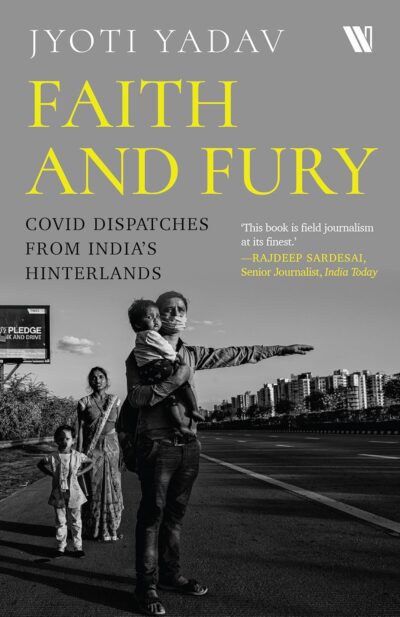
Jyoti Yadav’s Faith and Fury documents the human cost of Covid in India’s villages and small towns, focusing on migrant workers, rural distress, state failure, and lives left out of the national narrative.
Book: Faith and Fury: Covid Dispatches from India’s Hinterlands
Author: Jyoti Yadav
Form: Reportage / Indian non-fiction
Subject: Covid, rural India, migrant workers, and pandemic mismanagement
Main themes: lockdown, migrant workers, rural distress, public health, state failure, caste, poverty, grief, and memory
Best for: Readers interested in Covid reportage, rural India, journalism, public health, social inequality, and books by Indian women writers in English
Why I Picked Faith and Fury
I picked up Faith and Fury because the Covid years are still difficult to think about, yet they must not be forgotten. Like many of us, I remember the lockdown, the uncertainty, the fear, and the heartbreaking images of migrant workers walking back to their villages. But most of what we saw and discussed came from cities.
I wanted to understand what the pandemic looked like in India’s villages and small towns, especially for people who did not have the privilege of working from home, isolating safely, or depending on savings. That is what drew me to Jyoti Yadav’s ground reports from India’s hinterlands.
About Faith and Fury
The author takes readers into villages across northern India, especially Uttar Pradesh and Bihar, speaking with people on the ground — ordinary citizens, doctors, government officials, and politicians. The aim, to document how the pandemic was handled outside India’s big cities. What emerges is a picture of confusion and chaos: daily announcements, constantly changing guidelines, and an abrupt lockdown that was poorly thought through.
Migrant Workers, Lockdown, and Rural Distress
The stories of migrant workers walking hundreds, and sometimes thousands, of kilometres back to their villages in Uttar Pradesh and Bihar are heartbreaking. As if the journey itself was not cruel enough, many were beaten or chased away by the police for violating curfew. Only after widespread media coverage—much of it international—did the government announce Shramik trains for migrant labourers, promising to bear most of the cost. In reality, that promise largely remained unfulfilled.
As one reads through the book, the stark disconnect between how the pandemic was handled in cities and how it unfolded in villages becomes evident. With very few reporters on the ground in rural areas, most Covid coverage came from metro cities, effectively cutting off villages and tier-3 and tier-4 towns from the national narrative. Their experiences remained largely unseen, unheard, and undocumented – and this is one of the reasons everyone should read this book.
State Failure and Public Memory
As the book unfolds, it becomes evident that despite the enormity of the epidemic and the constant stream of government guidelines, the focus often remained on public relations and image management rather than effective implementation. There was a glaring gap between announcements and action. A telling example was the government’s own disregard for Covid protocols—large gatherings continued unabated. During the second wave, the Kumbh Mela was organised, drawing lakhs of people and raising serious concerns about mass gatherings during a public health crisis. At the same time, the Prime Minister addressed multiple election rallies, reducing Covid guidelines to little more than empty rhetoric.
The book brings together the stories of countless Indians—the hardships they endured, the loved ones they lost, and the indifference they encountered not only from the state but sometimes even from their own families and communities. Reading these accounts leaves you unsettled and reflective, forcing you to confront the human cost of apathy, mismanagement, and silence.
The book acts as a portal into the villages of Uttar Pradesh and Bihar, revealing how ordinary people—the poor and the marginalised—struggled to survive the pandemic. Each individual story stands as a stark indictment of systemic failure, not only because of mismanagement, lack of facilities, or the sheer scale of Covid, but because the system ultimately stripped citizens of their dignity by failing even to acknowledge their deaths. The author connects with ordinary people on an emotional level and presents their stories with empathy and humanity.
Writing Style
The book is written in simple, accessible language, though it is not always an easy read, often stirring deep emotion. We, and perhaps our present generation in particular—have a short memory when it comes to collective suffering, which is precisely why this book becomes such an important read. It serves as a reminder of what was endured, what was lost, and what must not be forgotten.
Who Should Read This Book
This book is especially useful for readers interested in Covid reportage, rural India, migrant workers, public health, journalism, and the social consequences of state policy. It is also important for those who followed the pandemic mainly through urban news coverage and want to understand what happened beyond India’s big cities.
Readers interested in books by Indian women writers in English will also find this an important work of reportage.
Our Verdict
Faith and Fury is an important and deeply human account of Covid in India’s hinterlands. Jyoti Yadav documents stories that could easily have disappeared from public memory — stories of migrant workers, rural families, grief, confusion, state failure, and the struggle to retain dignity during a time of fear.
The book matters because our collective memory of suffering is often short. It reminds us of what was endured, what was lost, and what must not be forgotten.
About the author
Jyoti Yadav is an award-winning journalist. Known for her fearless ground reporting at ThePrint, she has established herself as a long-form writer-reporter, capturing, over the past decade, social shifts that lurk unnoticed beneath ‘breaking news’ cycles. She is a chronicler of life in rural and small-town India at a time when journalism has shifted its focus to big cities and metropolitan urbanism.
Related Readings


About the reviewer
Manoj Payal
Manoj is an avid reader and a writer in progress, with interests spanning literature, history, politics, and the social sciences. His writing across book reviews, essays, articles, and poetry—explores ideas, society, and the human experience.He has spent over two decades working in the IT industry, a background that informs his analytical approach to reading and writing.