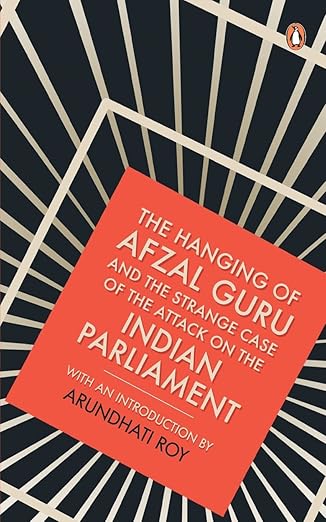
The Hanging of Afzal Guru is a collection of essays on the 2001 Parliament attack case, the trial and execution of Mohammad Afzal Guru, and the questions raised around investigation, due process, justice, and Kashmir. The book brings together writers, lawyers, journalists, and public intellectuals who challenge the dominant narrative around the case and ask whether justice was served. This review looks at the book’s arguments, its political importance, and why it remains a difficult but necessary read.
Book: The Hanging of Afzal Guru: And the Strange Case of the Attack on the Indian Parliament
Introduction: Arundhati Roy
Form: Essays / political non-fiction
Subject: Parliament attack case, Afzal Guru’s trial, execution, and due process
Main themes: justice, investigation, fair trial, capital punishment, Kashmir, state power, media narratives, and collective conscience
Best for: Readers interested in Kashmir, Indian politics, law, civil liberties, state power, and political non-fiction
Why I read -The Hanging of Afzal Guru
I read The Hanging of Afzal Guru because I wanted to understand the case beyond the dominant public narrative. Afzal Guru’s execution remains one of the most controversial moments in recent Indian political and legal history, especially because of the questions raised around investigation, trial, representation, secrecy, and Kashmir’s response. I wanted to read a book that looked at these questions closely rather than accepting the popular version of events without scrutiny.
About The Hanging of Afzal Guru
The Hanging of Afzal Guru is a compilation of essays by noted writers, lawyers, and journalists on the Parliament attack, the arrest of Afzal Guru and other accused, and the eventual execution of Afzal Guru.
These essays offer a perspective on the case that challenges the dominant narratives presented by mainstream print and electronic media. The book raises serious questions about the effectiveness of the investigation conducted after the Parliament attack, highlighting several inconsistencies and loopholes in the official narrative and legal process.
The Collective Conscience of Society
The execution of Afzal Guru was met with widespread protests in Kashmir, while it was celebrated by many in the rest of India. The stark contrast in reactions showed a deep and undeniable divide in public sentiment.
While pronouncing the death sentence, the Supreme Court bench used the phrase “collective conscience of society.” This phrase became central to later criticism of the judgment and the execution. Afzal Guru was arrested on 15 December 2001, along with three others, for his alleged role in the attack on the Indian Parliament on 13 December 2001. He was hanged on 9 February 2013.
The incident, which resulted in heavy casualties had shaken the entire nation, and the collective conscience of society will only be satisfied if capital punishment is awarded to the offender.
– Supreme Court Judgement
What the book asks us to think about is whether justice can be shaped by public sentiment. If the idea of collective conscience becomes central to awarding the death penalty, then it raises a serious question: where does law end and public emotion begin?
Loopholes in the Investigation
The introduction by Arundhati Roy poses serious questions about the Parliament attack of 13 December 2001. To be precise, there are thirteen questions, all of which remain important and relevant in the context of the book.
One of the questions she asks is:
“Why is it that we still don’t know who the five dead ‘terrorists’ killed in the Parliament attack are?”
Roy argues that when these unanswered questions are examined together, they point to something more serious than mere incompetence.
The book features essays by prominent voices such as Nandita Haksar, Vinod K. Jose, A. G. Noorani, Indira Jaising, and Mirza Waheed, all of whom raise critical concerns about the investigation process and the execution of Afzal Guru.
Trial, Execution, and Due Process
The Hanging of Afzal Guru does not seek to definitively judge his guilt or innocence. Rather, the essays argue that the fundamental issue is whether he received a fair trial.
The secrecy surrounding his execution, the refusal to allow his family a final meeting, and the denial of his body to his loved ones all point to serious procedural and ethical questions. His grave remains within the confines of Tihar Jail, far from his home and family.
This is what makes the book disturbing. It is not just about one case or one execution. It forces the reader to think about due process, state power, media pressure, and the way justice is understood when the accused belongs to a politically sensitive region like Kashmir.
Who Should Read -The Hanging of Afzal Guru
This book is useful for readers interested in Kashmir, Indian politics, law, civil liberties, capital punishment, and the relationship between state power and public opinion.
It is especially important for readers who want to understand why Afzal Guru’s execution continues to raise questions around investigation, legal representation, due process, secrecy, and justice.
Readers looking for a simple or neutral account of the Parliament attack case may find the book challenging because it is written as a counter-narrative. But for anyone willing to examine uncomfortable questions, it is an important read.
Our Verdict
The Hanging of Afzal Guru is an important book because it offers a critical counter-narrative to the widely accepted version of the Parliament attack case and Afzal Guru’s execution. The essays raise serious questions about investigation, trial, legal representation, media narratives, secrecy, and the use of the death penalty.
What makes the book significant is that it does not merely ask whether one man was guilty or innocent. It asks a larger question: what happens to justice when state power, public sentiment, media pressure, and Kashmir’s political reality come together?
For readers interested in Kashmir, civil liberties, and Indian democracy, this is a difficult but necessary book.
Related Readings
If The Hanging of Afzal Guru interests you, these related reviews may help you explore Kashmir, state power, nationalism, and contested narratives further. Kashmir: Rage and Reason looks at anger, politics, and public sentiment in Kashmir, while The Many Faces of Kashmiri Nationalism helps explain the region’s political history and competing identities. You may also find my broader list of books on Kashmir useful for reading different perspectives on the region.
About the reviewer

Manoj Payal
Manoj is an avid reader and a writer in progress, with interests spanning literature, history, politics, and the social sciences. His writing across book reviews, essays, articles, and poetry—explores ideas, society, and the human experience.He has spent over two decades working in the IT industry, a background that informs his analytical approach to reading and writing.