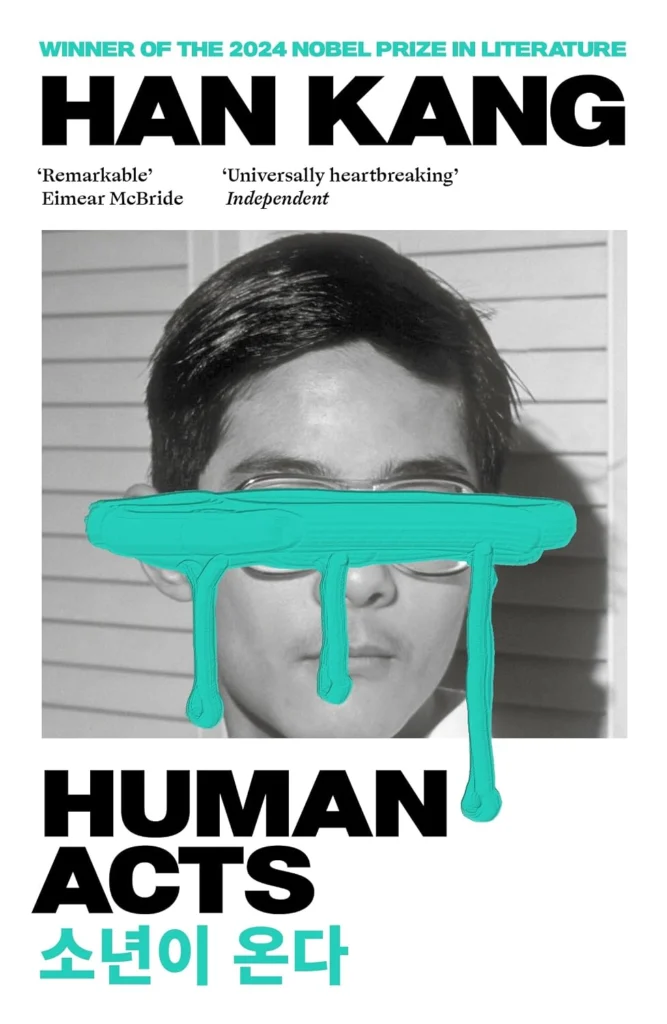
Human Acts by Han Kang is a work of historical fiction centered on the 1980 Gwangju Uprising in South Korea, a protest against martial law and military dictatorship. Park Chung-hee, the long-time authoritarian president who had come to power through a military coup in 1961, was assassinated in 1979. His death created a political vacuum that eventually allowed another army general, Chun Doo-hwan, to seize power and usher in a new period of military rule.
In May 1980, students and ordinary citizens in Gwangju revolted against the government, demanding democracy and an end to martial law. The military responded with extraordinary brutality. Human Acts explores this uprising and its violent suppression, while also following the lives of those who survived the massacre, imprisonment, and torture. Through their experiences, Han Kang examines not only the immediate horror of state violence, but also the lasting trauma it leaves on individuals and society.
Book: Human Acts
Author: Han Kang
Translated by: Deborah Smith
Form: Historical fiction / literary fiction / translated fiction
Subject: The 1980 Gwangju Uprising in South Korea and the trauma left behind by state violence
Main themes: Gwangju Uprising, military dictatorship, state violence, democracy, grief, memory, trauma, torture, survival, resistance, mourning, human dignity
Best for: Readers interested in historical fiction, political fiction, South Korean history, translated literature, state violence, dictatorship, memory, trauma, and emotionally intense literary writing.
Why I picked Human Acts
I had previously read a couple of books by Han Kang—The Vegetarian and Greek Lessons—and found both slightly difficult reads, though in different ways. Still, I was drawn to her writing style, especially her brevity and her ability to express so much with so few words. While browsing for my next read, I came across Human Acts, and its subject immediately fascinated me. I knew very little about the history and politics of South Korea, so I decided to read it to learn more and better understand that period.
About Human Acts
Human Acts captures the 1980 Gwangju Uprising through the perspectives of different people who were involved in it in various ways. It takes the reader to the scene of the uprising and brings us close to what the characters see, feel, and experience. The book is as much about the uprising itself as it is about its aftermath, showing what happens to the students, workers, families, and survivors whose lives are forever changed by it.
While reading, you are introduced to a part of South Korean history that many people outside the country may know very little about. The novel gives us a glimpse of life under a dictatorship and the consequences of resisting it. Families are torn apart, people lose their loved ones, and those who survive are left carrying the psychological scars of violence, imprisonment, and torture for years to come.
Human Acts begins with the story of a young boy named Dong-ho, who is searching for his friend Jeong-dae, who was shot by the army during the early days of the uprising. Dong-ho saw him being shot in front of him but could not help him because of the incessant firing. He eventually reaches a gymnasium that has been converted into a temporary morgue, as the regular morgue is already overflowing with bodies. There, he meets a few other people who are helping to sort and tag the bodies so that families can come and identify their loved ones.
The story then moves through the lives and perspectives of different people connected to the uprising—some are killed, some are imprisoned and tortured, while others are released only to live deeply scarred lives. Through them, we get a sense of what life was like for ordinary people before, during, and after the uprising. We see the years they spent under military dictatorship and how freedom became increasingly elusive during this period. The regime continued to keep watch over people associated with the uprising, making an already difficult life even harder for many of the survivors.
What is remarkable is how Han Kang portrays the horror of those times without sensationalising it. She does not shout, exaggerate, or openly condemn those in authority. Instead, the imagery she creates through her restrained prose makes the scenes intensely visual. You feel as though you are there among the piles of bodies, inside the gymnasium with Dong-ho, or in his home with his family. She does not tell the reader exactly what to feel; she simply paints the scene in precise detail and leaves the emotions to arise on their own.
The reflections of the survivors make you pause and wonder: Was it worth it? What did we achieve? Why didn’t we fire, or why couldn’t we fire, that day? These are some of the questions they continue to grapple with, without ever finding easy answers. At one point, someone says, “Conscience is the most terrifying thing in the world,” and the more you think about it, the more true it feels.
I especially liked the section narrated through Dong-ho’s mother, as she remembers her son and continues to live with the pain of losing him. Some emotions are universal and connect with us instantly, but it is the way Han Kang weaves her words that makes them resonate even more deeply. Only a writer of great skill could express such overwhelming grief in a voice that is so restrained, yet so profoundly moving.
Who Should Read Human Acts
I would recommend Human Acts to book lovers and avid readers, especially those interested in historical fiction. I had very little knowledge of South Korea’s political history before reading this book, and by the end of it, I felt much more informed about the country, its history, and its people. More importantly, the book made me curious to learn further. It encouraged me to read more about South Korea, and I am sure I will continue exploring its history, culture, and literature.
And anyone interested to read good literature should definitely read this one.
About The Author
Han Kang was born in Gwangju, South Korea, and moved to Seoul at the age of ten. She studied Korean literature at Yonsei University. Her writing has won the Yi Sang Literary Prize, the Today’s Young Artist Award, and the Korean Literature Novel Award. The Vegetarian, her first novel to be translated into English, was published by Portobello Books in 2015 and won the 2016 Man Booker International Prize. She is also the author of Human Acts (Portobello, 2016) and The White Book (Portobello, forthcoming 2017). She is the winner of Nobel prize for literature 2024. She is based in Seoul.
About the Translator
Deborah Smith’s translations from the Korean include two novels by Han Kang, The Vegetarian and Human Acts, and two by Bae Suah, A Greater Music and Recitation. In 2015 Deborah completed a PhD at SOAS on contemporary Korean literature and founded Tilted Axis Press. In 2016 she won the Arts Foundation Award for Literary Translation. She tweets as @londonkoreanist. Tilted Axis’ first titles includes a darkly erotic Bengali novella, an obliquely allegorical take on South Korea’s social minorities, and a feminist, environmentalist narrative poem from Indonesia, published as a ‘sight-impaired-accessible’ art book. These will be followed by translations from Thai, Uzbek, and Japanese.
Related Readings
About the reviewer
Manoj Payal
Manoj is an avid reader and a writer in progress, with interests spanning literature, history, politics, and the social sciences. His writing across book reviews, essays, articles, and poetry—explores ideas, society, and the human experience.He has spent over two decades working in the IT industry, a background that informs his analytical approach to reading and writing.