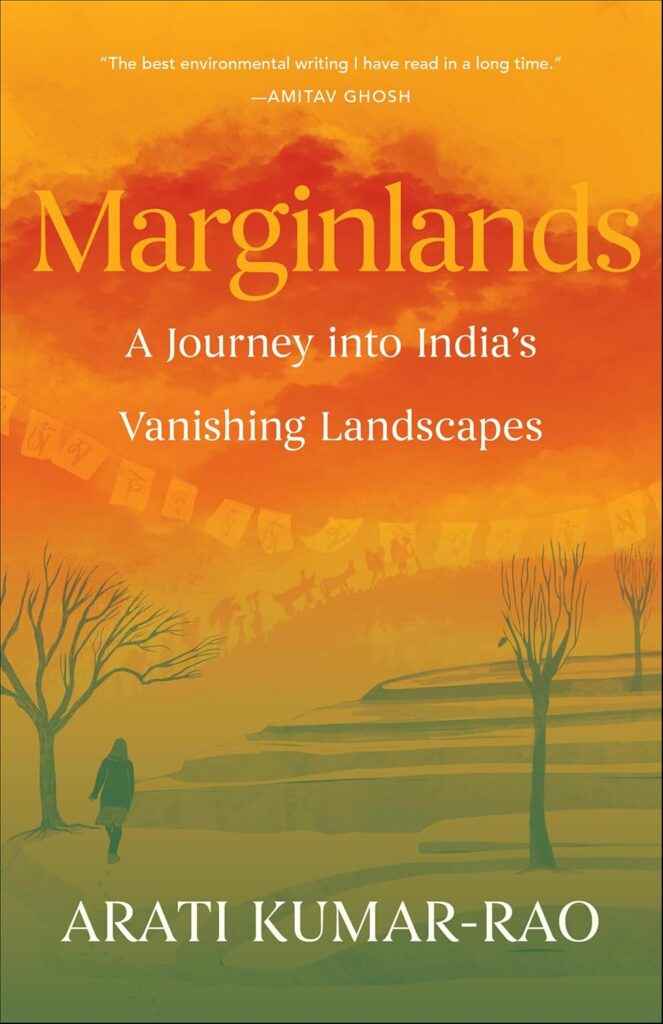
Marginlands: A Journey into India’s Vanishing Landscapes by Arati Kumar-Rao is about climate change and its impact on our environment, and as a result, on us. Through the lives of ordinary people, the book covers different parts of India and highlights how human intervention in the name of development is causing havoc in their lives. She takes readers on a journey from the Thar Desert to the Himalayas, from the basin of the Ganga to Arunachal Pradesh, and to the ecologically fragile coastal villages of Kerala. Arati opens a portal that takes us, the city dwellers, into these once ecologically rich but now vanishing landscapes — landscapes disappearing because of our own actions.
Book: Marginlands: Indian Landscapes on the Brink
Author: Arati Kumar-Rao
Form: Environmental non-fiction / reportage
Subject: India’s vanishing landscapes and the impact of climate change, development, and ecological neglect on people and nature
Main themes: climate change, environment, fragile landscapes, Thar Desert, Ganga, Himalayas, Ladakh, Arunachal Pradesh, coastal Kerala, local knowledge, displacement, rivers, mining, development, and ecological loss
Best for: Readers interested in climate change, environmental issues, Indian landscapes, people’s lives, development, ecology, and the human cost of environmental destruction.
Why I Picked Marginlands
I like to read books about our environment to understand how it is taken for granted, sometimes in the name of development, sometimes due to greed, and sometimes because of plain stupidity. There are many “developmental” projects by various governments across the world that do little to develop anything; instead, they damage entire ecological systems and invite environmental disasters. I have witnessed many such projects in the ecologically sensitive Himalayan region of India, especially Uttarakhand — be it all-weather roads, dams, or the rampant construction of hotels and apartments. These projects are carried out despite experts warning us about their dangers, and we have already seen the outcomes in the form of flash floods, landslides, road cave-ins, and collapsing bridges. So, when I came across Marginlands in the library while browsing for my next read, I decided to pick it up to know more about what the author had to say.
About Marginlands
Marginlands covers the vast expanse of India and shows readers how we are losing our landscapes because of our continued disregard for nature. What is deeply ironic is that the people who suffer the most are often the ones who understand these landscapes best and are trying to protect them. The author repeatedly shows that local knowledge is one of the best resources available before starting any project, but that knowledge is rarely respected or taken seriously.
The book takes us to the Thar Desert, a region that receives very little rainfall compared to many other parts of the country. Yet the people of the desert know how to use scarce water with great care. They have their own mechanisms to collect water, draw water, and use it wisely. It was interesting to learn about the different kinds of water sources that desert communities rely on. Unfortunately, mining in the desert is destroying these water sources and turning the areas around them into dust bowls.
Rivers, often considered the lifeline of a country, are also being polluted as industrial and sewage waste is dumped into them. The author tracks the Ganga in Bihar and West Bengal and brings us the stories of people who live near the river and depend on it for their livelihoods. She shows how climate change is affecting not only their work, but also their homes, as the river changes course and takes away parts of the land every year.
Various development projects, carried out without careful scientific studies or proper cost-benefit analysis, are also making rivers more unpredictable every year. The impact of these projects is felt most heavily by people whose livelihoods depend on the river, especially fishermen. Fish are becoming scarce, and there is always the fear of losing one’s home when the river takes away another part of the land.
Arati then takes the reader to coastal Kerala, the cold desert of Ladakh in the Himalayas, and the deep forests of Arunachal Pradesh. The central theme remains the same everywhere: climate change and its impact on people, animals, and fragile landscapes. Whether it is the tiger-widows of the Sundarbans, the threat of wild dogs in Ladakh, or the fishers of Kerala, everyone is affected in some way. The book repeatedly stresses the need to work with local people while formulating “development” plans, and to use their knowledge to find solutions that help everyone.
The author also draws attention to how city life is becoming increasingly devoid of nature, which was not the case thirty or forty years ago. The greenery in our cities is slowly being replaced by cosmetic gardens maintained with pesticides, which kill or drive away insects and other small creatures that are part of ecological diversity. We hardly see the bees, ants, and other insects that were common in our childhood, and that is not a good sign.
While reading, I came across many facts I was not aware of, apart from the names of birds, insects, and flora that the author captures. I found the information about beri, rejwani pani, and patali kuan especially interesting. I also never knew that out of nearly 700 types of bees, only about five are social bees, meaning they live in hives and produce honey. The rest are solitary. They do not have a queen bee or a hive, and they live independently.
The book is a treasure trove of knowledge and information, but it is also painful to read because so many places and landscapes are slowly vanishing. Some of the places we see and know today may not exist in the future, at least not in the same way. What makes it even more frustrating is that some of this damage can be stopped, or at least delayed, if proper studies are done and experts and local people are consulted before approving and executing “development” projects.
Who Should Read Marginlands
Marginlands is for everyone concerned about climate change, the environment, and the future of our landscapes. It is especially important for readers who care about the country and its people, and who want to understand how environmental damage affects ordinary lives. Anyone who wants to be better informed about climate issues, development projects, rivers, forests, deserts, mountains, and the fragile relationship between people and nature should read this book.
Our Verdict
Marginlands is an informative, moving, and deeply important book about India’s vanishing landscapes. Arati Kumar-Rao takes readers from deserts and rivers to mountains, forests, coasts, and cities, showing how climate change and careless development are changing the lives of people who depend most closely on nature.
What makes the book powerful is that it does not speak of the environment in abstract terms. It brings forward the lives of ordinary people, their local knowledge, their struggles, and the damage caused when development ignores ecology. The book is a treasure trove of knowledge, but it is also painful to read because it reminds us that many landscapes we know today may not exist in the same way in the future. For anyone concerned about the environment, this is an essential read.
About the author
Arati Kumar-Rao documents environmental degradation that has reached cataclysmic levels. She chronicles anthropogenic changes in landscapes and their fallouts on livelihood and culture — and how drastically depleting groundwater, habitat destruction and land acquisition for industry devastates biodiversity and shrinks common lands, displacing millions and pushing species toward extinction.
Her first book, “Marginlands: India’s Landscapes on the Brink,” encapsulates her work thus far on these themes. “Marginlands” was shortlisted for best first book in the non-fiction category at TataLitLive! Awards 2023, and longlisted for non-fiction at AttaGalatta Bangalore LitFest Awards 2023. Most recently, Kumar-Rao was included as a climate pioneer on the BBC’s 100 Women list for 2023.
Related Readings
If Marginlands interests you, these related reviews may help you explore environment, science, governance, and people’s lives further. The Phantom Plague looks at public health, science, and the cost of ignoring evidence, while Despite the State examines how governance failures affect ordinary Indians. Readers interested in land, rural struggles, and people’s movements may also find Land, Guns, Caste, Woman useful. The Case for Reason connects with the need for scientific temper and informed decision-making,




About the reviewer

Manoj Payal
Manoj is an avid reader and a writer in progress, with interests spanning literature, history, politics, and the social sciences. His writing across book reviews, essays, articles, and poetry—explores ideas, society, and the human experience.He has spent over two decades working in the IT industry, a background that informs his analytical approach to reading and writing.