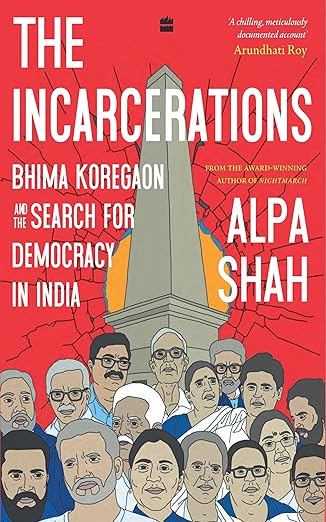
The Incarcerations by Alpa Shah is a deeply researched book about the Bhima Koregaon case, the arrest of the BK-16, and the larger questions it raises about democracy, dissent, state power, and human rights in India. Through the lives of sixteen lawyers, academics, activists, poets, and writers, Shah examines how a commemorative gathering was turned into a national security case. This review looks at how the book explains Bhima Koregaon, the allegations of planted evidence, and the disturbing implications of the case for Indian democracy.
Book: The Incarcerations: Bhima Koregaon and the Search for Democracy in India
Author: Alpa Shah
Form: Political non-fiction / reportage / anthropology
Subject: The Bhima Koregaon case and the arrest of the BK-16
Main themes: Bhima Koregaon, BK-16, democracy, dissent, UAPA, Dalit rights, Adivasi rights, state power, planted evidence, cyber surveillance, political repression, and human rights
Best for: Readers interested in Indian politics, democracy, civil liberties, caste, dissent, political prisoners, state power, and contemporary Indian non-fiction
Why I Picked - The Incarcerations
The first day of 2018 began with violence at Bhima Koregaon. Every year, on 1 January, people from across Maharashtra gather to pay tribute at a war memorial commemorating the historic battle of 1818. That year marked the 200th anniversary of the battle, in which a British regiment that included Dalit soldiers defeated the upper-caste Peshwa forces.
For many upper-caste groups, this commemoration has long been a sore point. But in 2018, the event took a disturbing turn when Hindutva groups, allegedly with political backing, violently disrupted it.
Initially, the police filed charges against two Hindutva leaders accused of inciting the violence. However, within a few months, the narrative shifted dramatically. Authorities instead targeted sixteen lawyers, activists, and academics, many of whom were not even from Maharashtra, and many of whom had been vocal in their support for Dalit rights. I was following the case closely, and to understand it better, I decided to read this book.
About - The Incarcerations
The Incarcerations by Alpa Shah offers a detailed and deeply researched account of the Bhima Koregaon incident of 2018. Shah explores different aspects of the Bhima Koregaon case in depth. She examines the historical significance of Bhima Koregaon, what happened on 1 January 2018, and how events unfolded after that.
The book also gives us a glimpse into the lives of the BK16, the sixteen people arrested in the Bhima Koregaon case. Shah looks at who they are, what work they were doing, and how, according to the book, they were falsely implicated. She digs deep into the investigation process to show how the state and non-state machinery were allegedly used to implicate the BK16. The author also highlights how the government and its underlying ideology, in her view, pose a threat to democracy in India.
The BK-16 refers to a group of 16 human rights defenders, academics, lawyers, and artists imprisoned in connection with the Bhima Koregaon-Elgar Parishad case in India.
Knowing the BK16
The author provides vivid character sketches of the BK16 accused. While reading about them, I felt gratitude and a profound sense of respect for the work they have been doing.
The BK16 include a wide range of individuals: lawyers and academics such as Sudha Bhardwaj, Hany Babu, and Anand Teltumbde; artists such as Jyoti Jagtap, Sagar Gorkhe, and Ramesh Gaichor of the Kabir Kala Manch; and activists and writers such as Gautam Navlakha, Varavara Rao, and Father Stan Swamy.
Reading about each of them was an enriching experience for me, and I am sure it will inspire readers as well. They stood in solidarity with some of the most marginalized communities in India, including Adivasis, Dalits, and others who continue to face neglect and injustice from the state.
A Brief History of Bhima Koregaon
The Incarcerations explains the historical significance of the annual Bhima Koregaon victory celebrations and the causes of conflict and violence around them. This gives readers the context needed to understand why violence broke out in January 2018.
As I turned the pages, I came to understand that at the core of this conflict lies the caste system and the hegemony of the upper castes. The author provides a chronology of events, the violence, the prelude to the violence, and the charge sheet filed by the police immediately after the incident. This helps readers understand how the event unfolded and how the investigation and actions initially taken by the Pune police were later overturned.
Conspiracy to Implicate the BK16
The book documents how the initial investigation was set aside and fresh charges were filed against the BK16, implicating them in the Bhima Koregaon violence. They were accused of being part of a conspiracy to assassinate the Prime Minister and were booked under the UAPA, the Unlawful Activities (Prevention) Act.
Shah undertakes extensive research to uncover the truth behind the case. She presents a detailed account of how, according to forensic findings discussed in the book, false evidence was planted on the laptops and phones of some of the activists. She explains how NetWire, a type of malware, was allegedly used to infiltrate their devices and insert incriminating documents.
To support these claims, the book draws on the findings of cybersecurity firm SentinelOne and forensic experts at Arsenal Consulting. Reading about this left me deeply unsettled. The scale of resources and effort that a state can mobilize to fabricate a case against its own citizens is truly alarming.
My Experience
Reading this book was a truly eye-opening experience. Although I had some prior knowledge of the Bhima Koregaon incident and its historical context, this book offered a powerful and revelatory perspective. It gives a comprehensive account of the 2018 events and sheds light on how the government allegedly manipulated the situation to target the BK16.
Filled with facts and insights, The Incarcerations reveals how a simple commemorative gathering was reframed as a national security threat. It offers a chilling look at the state’s apparent obsession with suppressing dissent and the disturbing lengths it is willing to go to achieve that.
Who Should Read This Book
The Incarcerations is for anyone interested in politics, democracy, civil liberties, and the frightening power of the state. It is especially important for readers who want to understand how state power and state machinery can be used to implicate citizens in serious crimes and keep them in jail without trial.
The book shows the extent to which resources, institutions, laws, and investigative agencies can be mobilized against people who question power or stand with the marginalized. It is also an essential read for anyone trying to understand the dangers of unchecked authority and what happens when dissent is treated as a threat to the nation.
Our Verdict
The Incarcerations is an essential read. It cuts through the media fog surrounding the Bhima Koregaon case and exposes the unsettling questions behind it.
What makes the book powerful is not only the case itself, but the larger warning it carries about democracy, dissent, and the vulnerability of citizens before state power. It leaves you disturbed, angry, and more aware of how fragile justice can become when institutions are used to silence those who question power.
About the author
Alpa Shah was raised in Nairobi, studied at Cambridge, and completed her PhD at the London School of Economics, where she now teaches anthropology. She is the author of In the Shadows of the State and Nightmarch, and a co-author of Ground Down by Growth. She has also written and presented for BBC Radio 4’s Crossing Continents and From Our Own Correspondent.
Related Readings


About the reviewer
Manoj Payal
Manoj is an avid reader and a writer in progress, with interests spanning literature, history, politics, and the social sciences. His writing across book reviews, essays, articles, and poetry—explores ideas, society, and the human experience.He has spent over two decades working in the IT industry, a background that informs his analytical approach to reading and writing.