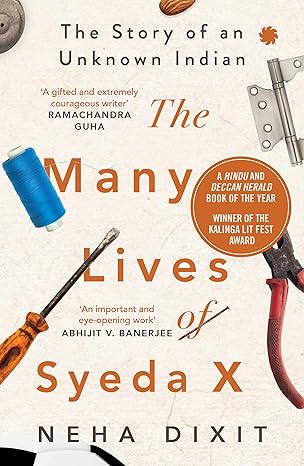
The Many Lives of Syeda X by Neha Dixit is a deeply moving work of reportage about women’s labour, poverty, migration, Muslim identity, and survival in India. Through the life of Syeda, an ordinary woman who has worked more than fifty informal jobs, the book reveals the invisible labour that sustains cities but rarely enters public memory. This review looks at why Syeda’s story matters, not only as one woman’s biography, but as a portrait of countless women whose lives remain unseen.
Book: The Many Lives of Syeda X
Author: Neha Dixit
Form: Reportage / biography / Indian non-fiction
Subject: Women’s labour, migration, poverty, and survival in India
Main themes: informal work, Muslim identity, poverty, migration, gender, communal violence, unpaid labour, dignity, and resistance
Best for: Readers interested in women’s lives, labour, Indian society, reportage, social justice, and books by Indian women writers in English
Why I Picked - he Many Lives of Syeda X
I picked up The Many Lives of Syeda X after hearing it described as the story of an “unknown Indian woman.” That phrase stayed with me. Unknown, despite living and working in India for over three decades. Unknown, despite being the backbone of an economy that does not even acknowledge her. It made me pause. How many such women do we walk past every day without noticing?
About -The Many Lives of Syeda X
Neha Dixit’s book is not just a biography. It is a portrait of a life most of us never see, because we have not looked closely enough. Through Syeda’s story, we meet a woman who has held more than fifty informal jobs in her lifetime, some of which I had never even heard of. From shelling almonds to assembling lights, from sewing school bags to making passport photo booklets, Syeda’s hands have touched parts of everyday life we take for granted.
Informal Labour and Invisible Women Workers
The book traces Syeda’s journey from her early years in Banaras to her adult life in Delhi. Along the way, we see her navigate poverty, communal tensions, domestic struggles, and systemic indifference. Her story isn’t one of big moments or dramatic events. It’s the kind of life that plays out in rented rooms, under flickering tube lights, across years of unpaid dues and ignored efforts. But that’s exactly how life is for most of our population, especially Muslims.
There is something deeply moving about how Dixit tells Syeda’s story. The writing is understated and never tries to romanticize her struggle. The tone is respectful and patient, letting Syeda’s reality speak for itself. We aren’t forced to pity her; instead, we come to admire her resilience, even as we ache for everything she is denied.
What stayed with me most was how Syeda kept going. Despite her circumstances, despite being underpaid and overworked, despite having her voice ignored repeatedly, she continues. She shows up. She works. She organises. She raises her children. She even leads a small strike with other women workers. Her resistance may not make headlines, but it’s there in her refusal to disappear.
Migration, Communal Violence, and Survival
The author captures how Syeda’s life is shaped by events that many of us remember only as news: the communal riots in Banaras, the Babri Masjid demolition, demonetisation, and the Delhi riots of 2020. But for her, these were not just political shifts; they had direct consequences. A riot means a job lost. A policy change means wages are delayed. A label placed on her community means suspicion and fear.
The personal is always political for women like Syeda, even when they have no say in the decisions being made.
Reshma, Inherited Hardship, and Broken Dream
One section that really struck me was about Syeda’s daughter, Reshma. A bright student with dreams, she ends up leaving school and joining her mother in low-paid work to support the family. It felt like history repeating itself. How many dreams are crushed quietly like this, and how many stories end before they even begin?
Dixit also captures the unspoken toll this life takes on a woman’s body and spirit. There is a weariness in Syeda’s words as she grows older, a kind of quiet acceptance, but also a fatigue that creeps into her bones. And yet, even when she speaks of giving up, she never really does. There is something profoundly brave in that.
The book does not offer solutions. It does not wrap Syeda’s life in a neat ending. There is no big reward, no dramatic turning point. But maybe that is the point. Not all lives end with closure or justice. Some just continue, day after day, through grit alone.
Writing Style
There is something deeply moving about how Dixit tells Syeda’s story. The writing is understated and never tries to romanticise her struggle. The tone is respectful and patient, letting Syeda’s reality speak for itself. We are not forced to pity her; instead, we come to admire her resilience, even as we ache for everything she is denied.
Reading The Many Lives of Syeda X was not easy. It was emotional, and in some ways it reminded me of Heart Lamp by Banu Mushtaq. It was infuriating at times. And it made me deeply uncomfortable to realise how little I knew about the invisible workforce that sustains this country. But it also made me grateful that someone took the time to tell this story, with honesty, with care, and without spectacle.
Who Should Read The Many Lives of Syeda X
The Many Lives of Syeda X is an important book. It is raw, real, and likely to stay with you long after you turn the last page. It is not just Syeda’s story; it is the story of countless women whose lives remain unrecorded.
This book reminded me that survival, too, is an act of resistance. That quiet strength can be revolutionary. And that we owe it to women like Syeda, not just to read their stories, but to question the systems that keep them unseen.
If we are lucky, more such stories will be written. More importantly, they will be read.
About the Author
Neha Dixit is an independent journalist based in New Delhi. She has covered politics, gender, and social justice for seventeen years. Most of her work is investigative, narrative, and long-form. She has reported for Al Jazeera, The Washington Post, The New York Times, The Caravan, The Wire, and other notable publications.
Related Readings
If The Many Lives of Syeda X moved you, these related reviews may help you explore similar questions of labour, poverty, women’s lives, migration, and social invisibility. Nine Rupees an Hour looks at rural livelihoods and dignity, Faith and Fury documents crisis and neglect during Covid, while Heart Lamp turns toward the inner lives of Muslim women through fiction.
About the reviewer

Manoj Payal
Manoj is an avid reader and a writer in progress, with interests spanning literature, history, politics, and the social sciences. His writing across book reviews, essays, articles, and poetry—explores ideas, society, and the human experience.He has spent over two decades working in the IT industry, a background that informs his analytical approach to reading and writing.