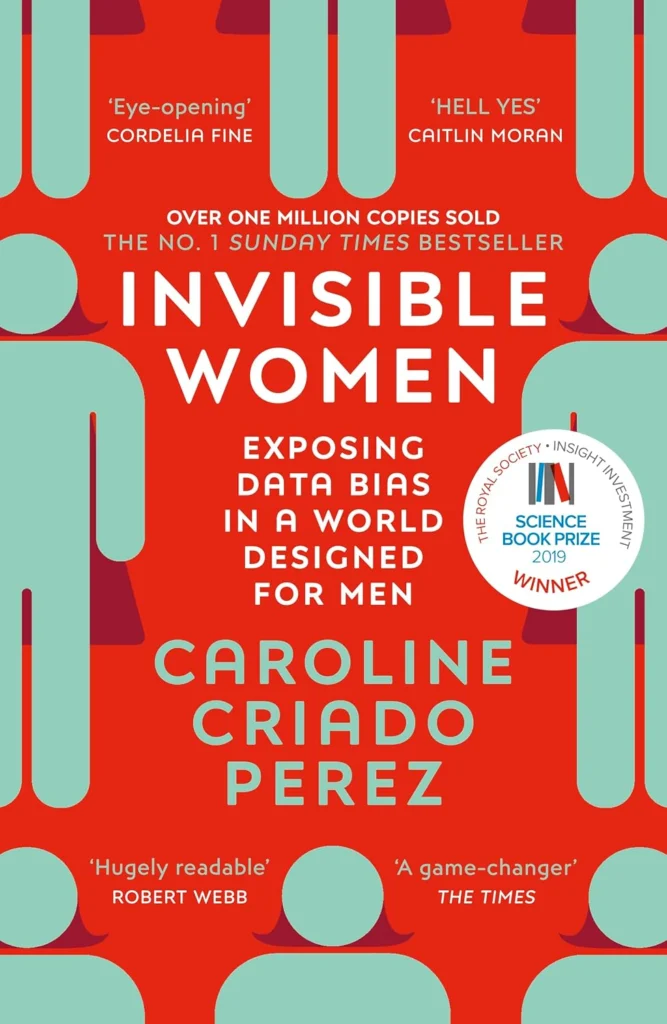
Invisible Women: Data Bias in a World Designed for Men by Caroline Criado Perez explores how gender data bias shapes the modern world. From healthcare and workplaces to public policy, infrastructure, and design, women are often missing from the data used to make important decisions. The book shows how treating men as the default human being affects women’s lives and harms society as a whole.
Book: Invisible Women: Data Bias in a World Designed for Men
Author: Caroline Criado Perez
Form: Non-fiction / feminist social commentary
Subject: Gender data bias and how systems are designed around male experiences
Main themes: gender bias, data gaps, women’s health, workplace inequality, unpaid labour, transport, technology, public policy, safety, and design
Best for: Readers interested in feminism, gender equality, social justice, public policy, data bias, women’s lives, and non-fiction books by women writers
Why I picked - Invisible Women
I first came across a reference to Invisible Women while reading another book. I was immediately intrigued by its title and curious about what it had to offer.
To be honest, before reading this book, I was largely unaware that data could be examined separately for men and women and that such distinctions could significantly influence policy decisions. I had never given much thought to the possibility that supposedly neutral statistics might represent only one section of society.
Curious to understand the idea better, I decided to take the plunge. What followed was an eye-opening reading experience that completely changed the way I look at data, design, public spaces, workplaces, and healthcare.
About Invisible Women
Invisible Women is the result of a meticulous examination of hundreds of studies conducted in different parts of the world. Through research papers, statistics, case studies, and real-life examples, Perez demonstrates how women are frequently ignored in almost every sphere of life.
The central argument of the book is that the male experience is often treated as the universal human experience. When researchers fail to collect gender-specific data, the needs of women remain invisible. As a result, decisions that appear neutral may disadvantage women.
The strength of the book lies in its range. Perez does not restrict her discussion to one country or one area of life. She explores transportation, urban planning, employment, medicine, technology, politics, disaster relief, and many other fields. Together, these examples reveal that the gender data gap is neither occasional nor accidental. It is systematic.
Data Bias and Its Impact on Everyday Life
One of the most interesting aspects of the book is its discussion of how data bias affects ordinary activities.
The example of snow clearing particularly stayed with me. In many cities, the main roads are cleared first because they are considered the most important routes. These roads are often used by people travelling directly to and from work, a pattern traditionally associated more with men.
Women, however, are more likely to walk, use public transport, accompany children, shop for household necessities, or make several shorter trips in a day. They therefore depend more heavily on pavements, pedestrian paths, and smaller roads.
When these areas are cleared last, women face a greater risk of slipping, falling, and getting injured. What appears to be a simple and neutral decision about snow removal is influenced by whose travel patterns are treated as important.
This example made me realize that even basic infrastructure decisions can carry hidden assumptions.
Data Bias in the Workplace
The book also examines how workplaces are often designed around the average male body and the traditional male working pattern.
Office temperatures, protective clothing, safety equipment, tools, and uniforms are frequently based on male measurements. As a result, women may have to work in environments that are physically uncomfortable or even unsafe.
Another example is that of Sheryl Sandberg, who later became COO of Facebook. While working at Google during her pregnancy, she requested parking spaces closer to the office after struggling with the long walk from the parking area.
The fact that this need had not been considered earlier shows how workplaces often overlook women’s experiences until they are directly represented in decision-making.
Data Bias in Healthcare
The healthcare chapters are among the book’s most disturbing. Medical research has often treated the male body as the standard, excluding women from clinical studies and developing treatments largely from male data.
Yet women may experience diseases differently, show different symptoms, and respond differently to medication. Relying mainly on male data can therefore lead to misdiagnosis, inadequate treatment, or incorrect dosages. In healthcare, the gender data gap is not merely academic; it can become a matter of life and death.
Writing Style
Caroline Criado Perez supports her arguments with extensive research, using studies, statistics, and global examples throughout the book.
Although the amount of information can sometimes feel dense, it is also the book’s greatest strength. Perez explains the bias clearly and backs every claim with evidence. Her writing is direct, forceful, and accessible even to readers without an academic background.
Who should Read – Invisible Women
This book was an eye-opening experience for me. Although I read widely, I had never realised how deeply data can be biased towards men—from crash tests and healthcare research to workplace tools and kitchen design.
I would recommend Invisible Women to every reader, especially those interested in gender equality, public policy, healthcare, technology, and social issues. It changes the way we look at data and the systems built around us.
Our Verdict
Invisible Women is a well-researched and well-written book that makes you pause and question many things we usually take for granted. Through compelling evidence and real-life examples, it reveals how deeply gender bias is embedded in data and everyday systems. Although some sections are heavy with data, the book remains engaging and thought-provoking.
I am sure it will make you question and unlearn many assumptions, as it did for me.
About The Author
Caroline Criado Perez is a writer, broadcaster and award-winning feminist campaigner. Her most notable campaigns have included co-founding The Women’s Room, getting a woman on Bank of England banknotes, forcing Twitter to revise its procedures for dealing with abuse and successfully campaigning for a statue of suffragist Millicent Fawcett to be erected in Parliament Square.
She was the 2013 recipient of the Liberty Human Rights Campaigner of the Year Award, and was awarded an OBE in the Queen’s Birthday Honours 2015. Her first book, Do it Like a Woman, was published in 2015. She lives in London.
Related Readings


About the reviewer

Manoj Payal
Manoj is an avid reader and a writer in progress, with interests spanning literature, history, politics, and the social sciences. His writing across book reviews, essays, articles, and poetry—explores ideas, society, and the human experience.He has spent over two decades working in the IT industry, a background that informs his analytical approach to reading and writing.